Secure coding in action
Secure Code Warrior builds a culture of security-driven developers by giving them the skills to code securely. Our Learning Platform delivers relevant hands-on missions and contextual tools for developers.
An industry-first benchmark that quantifies the impact of your secure coding program
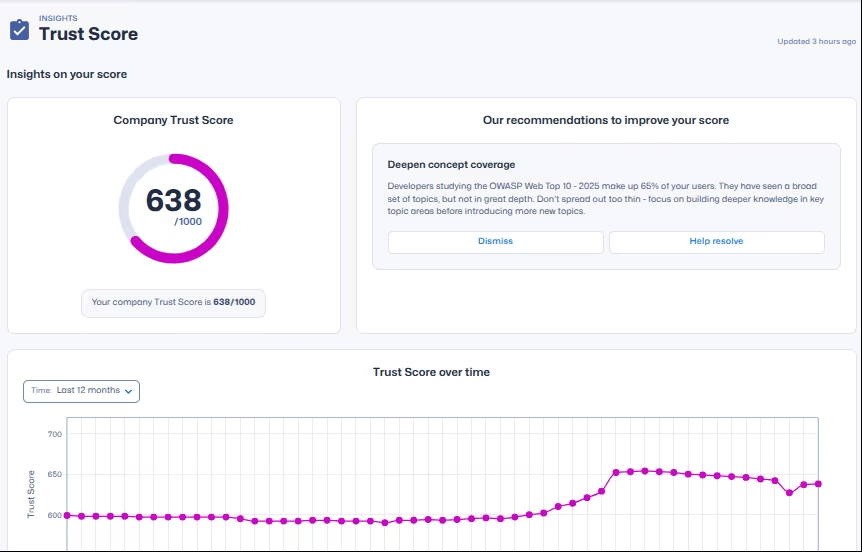
The SCW Trust Score is an innovative offering designed to revolutionize the way organizations approach secure coding and application security. By providing a comprehensive assessment of your development team's secure coding skills, the SCW Trust Score enables AppSec teams and CISOs to gain a holistic understanding of their team's competencies and pinpoint areas for optimization.

Empower your organization to benchmark your performance against your peers. Set a standard for your security program that meets your needs and achieves your business outcomes.

Reduce risk, achieve regulatory compliance, and prevent common software vulnerabilities before they become a larger issue.

Embed a security mindset into your development process with hands-on, relevant learning beyond developer training.
Secure Code Warrior builds a culture of security-driven developers by giving them the skills to code securely. Our Learning Platform delivers relevant hands-on missions and contextual tools for developers.
The SCW Trust Score is an innovative offering designed to revolutionize the way organizations approach secure coding and application security. By providing a comprehensive assessment of your development team's secure coding skills, the SCW Trust Score enables AppSec teams and CISOs to gain a holistic understanding of their team's competencies and pinpoint areas for optimization.
Software teams across enterprises are under more pressure to deliver quality, secure code faster and without fail before production. This has given rise to the concept of developer-driven security, a powerful movement that results in faster developer productivity, expedited movement throughout the software development cycle, and increased innovation, which ultimately leads to business growth.

In the dynamic landscape of Banking and Financial Services, safeguarding sensitive financial data is paramount. Implementing secure coding programs helps ensure the integrity and confidentiality of sensitive data, safeguarding organizations from breaches. This includes adhering to industry standards and regulations, such as PCI DSS and GDPR, and employing techniques like input validation, encryption, and access controls.

In the Technology sector, secure coding programs address vulnerabilities from intricate architectures and interconnected systems. Compliance with data privacy regulations and rapid development cycles highlight the necessity of integrating security into the development process. This also means having teams stay educated on OWASP, NIST, and ISO standards to ensure software system resilience in the face of modern challenges.


Provides visibility into the effectiveness of your organization’s security program by aggregating individual developer security expertise as they use Secure Code Warrior. Filter reports by language, team, or category for improved team accountability. Identify areas to coach and promote developer skills.

Empower your organization to benchmark your performance against your peers. Set a standard for your security program that meets your needs and achieves your business outcomes.

SCW Trust Score is underpinned by a dynamic algorithm that leverages more than 20-million learning data points from 600+ companies and 250,000 learners.
This litmus test provides the baseline of the current state of your security learning program, assesses its effectiveness, and enables your teams to optimize performance.
.png)
The enterprise technology landscape is shifting with a velocity few predicted until it was too late. We have officially crossed the threshold from human-written code and basic copilot assistance, into the era of the Agentic Development Lifecycle (ADLC). While autonomous AI agents promise unprecedented efficiency across multiple functions, they also bring an entirely new class of security and regulatory risks.
%252520(1).avif)
Proud to be a Silver Sponsor of OWASP Global AppSec USA 2026, celebrating its 25th anniversary on November 5–6, 2026, at the Hyatt Regency in San Francisco! Join us and 800+ application security professionals for sessions on AI security, threat modeling, a Capture the Flag competition, the OWASP Projects Demo Room, and exclusive networking receptions. Come find us there and let's connect!