hero bg no divider
Blog

Secure coding learning that reflects real AI usage
Shannon Holt
Published Jun 01, 2026
Last updated on Jun 01, 2026

Secure coding learning aligned to real AI usage, developer workflows, and modern software development practices.

AI-assisted development is already becoming part of everyday engineering work.

A developer may manually write core application logic in the morning, use AI to generate test coverage in the afternoon, then review AI-assisted pull requests before the end of the day. The workflows are fluid. The tooling changes quickly. Usage patterns evolve week to week, sometimes team to team.

Historically, secure coding learning operated on relatively fixed cycles — onboarding pathways, annual assignments, broad role-based training, or periodic awareness campaigns. Those models made sense when development tooling evolved more gradually and learning requirements stayed relatively stable over time.

AI-assisted development moves differently. Security teams now need a more responsive way to keep secure coding guidance connected to how developers are actually working in the moment.

Adaptive Learning is designed to help organizations align secure coding learning to real software development activity and software risk signals across the SDLC.

That includes AI-assisted development activity, vulnerability findings, and evolving developer behavior tied to how software is actually being built.

In this post, we’re focusing specifically on Adaptive Learning with AI Signals powered by Trust Agent: AI — using AI-assisted development detections to help organizations dynamically align secure coding guidance to developers actively using AI coding tools in day-to-day development work.

Learning That Reflects Real AI Usage

Secure coding learning has always been most effective when it reflects the way developers actually work. Organizations already align learning by role, coding language, technology stack, and vulnerability focus areas to make training more relevant across engineering teams.

AI-assisted development introduces an additional layer of context.

An engineer experimenting with AI-generated Python code today may spend next month reviewing infrastructure-as-code in Terraform or using AI to accelerate frontend testing workflows. Some developers rely heavily on AI coding assistants. Others barely touch them.

Adaptive Learning helps organizations turn AI visibility into targeted secure coding guidance. When Trust Agent: AI identifies AI-assisted development activity, organizations can automatically assign learning aligned to those workflows.
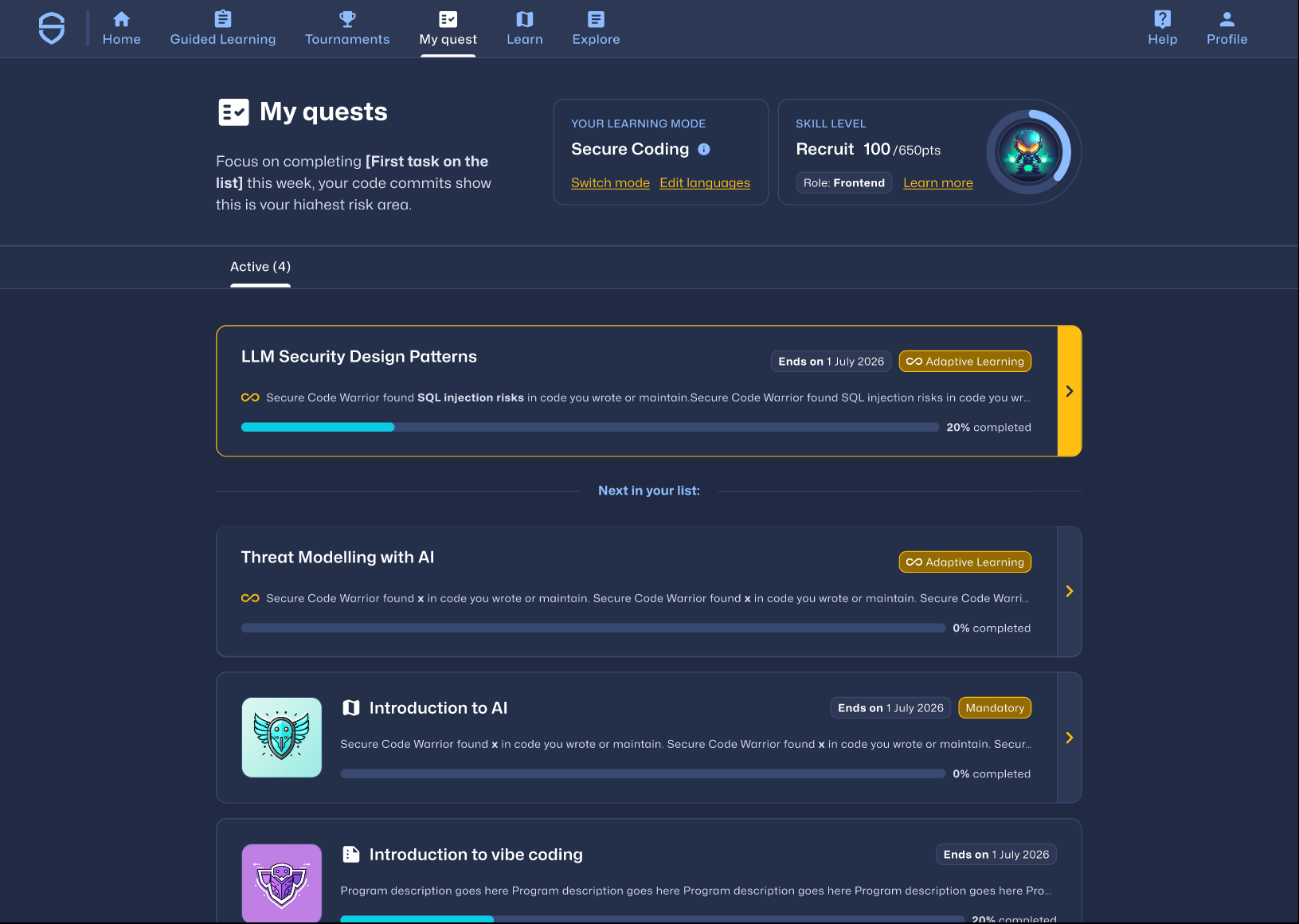
That means developers actively using AI coding assistants can receive targeted learning tied to the work already happening inside their environment — without security teams manually identifying individual developers and repeatedly reassigning learning as AI usage expands across engineering teams.

Adaptive Learning in Practice

Adaptive Learning powered by Trust Agent: AI is designed to fit naturally into existing software development workflows.

Security teams can create targeted learning aligned to secure AI-assisted development practices, then use Trust Agent: AI detections to dynamically assign that learning to developers actively using AI coding tools in their day-to-day workflows. As developers begin interacting with AI-assisted development environments, relevant secure coding guidance is automatically assigned based on that activity.


The walkthrough above demonstrates how Adaptive Learning with AI Signals works in practice, including configuring Trust Agent Detection, creating adaptive Quests, dynamically assigning learning, and tracking participation and completion.

For step-by-step setup instructions and configuration details, explore the adaptive Learning with Trust Agent: AI knowledge base article.

Secure Coding Guidance Should Reflect How Developers Actually Work

AI-assisted development is already part of everyday engineering workflows. Developers are moving quickly between AI-generated suggestions, manually written code, automated testing, and pull request review throughout the day.

As those workflows continue evolving, secure coding guidance needs to stay connected to the way software is actually being built.

Adaptive Learning powered by Trust Agent: AI helps organizations do exactly that — aligning learning to real AI-assisted development activity so guidance reaches developers when it is most relevant and actionable. 

The result is secure coding guidance that stays relevant as AI tooling evolves — without adding overhead to the security teams responsible for running the program.

Ressource ansehen
Ressource ansehen

Align secure coding training to real AI development activity — automatically assigning guidance to developers using AI tools, without manual intervention.Align secure coding training to real AI development activity — automatically assigning guidance to developers using AI tools, without manual intervention.

Interessiert an mehr?

Shannon Holt ist eine Marketingfachfrau für Cybersicherheitsprodukte mit einem Hintergrund in den Bereichen Anwendungssicherheit, Cloud-Sicherheitsdienste und Compliance-Standards wie PCI-DSS und HITRUST.

learn more

Secure Code Warrior ist für Ihr Unternehmen da, um Ihnen zu helfen, Code während des gesamten Softwareentwicklungszyklus zu sichern und eine Kultur zu schaffen, in der Cybersicherheit an erster Stelle steht. Ganz gleich, ob Sie AppSec-Manager, Entwickler, CISO oder jemand anderes sind, der sich mit Sicherheit befasst, wir können Ihrem Unternehmen helfen, die mit unsicherem Code verbundenen Risiken zu reduzieren.

Eine Demo buchen
Teilen auf:
linkedin brandsSocialx logo
Autor
Shannon Holt
Published Jun 01, 2026

Shannon Holt ist eine Marketingfachfrau für Cybersicherheitsprodukte mit einem Hintergrund in den Bereichen Anwendungssicherheit, Cloud-Sicherheitsdienste und Compliance-Standards wie PCI-DSS und HITRUST.

Shannon Holt ist eine Marketingfachfrau für Cybersicherheitsprodukte mit einem Hintergrund in den Bereichen Anwendungssicherheit, Cloud-Sicherheitsdienste und Compliance-Standards wie PCI-DSS und HITRUST. Ihre Leidenschaft ist es, sichere Entwicklung und Compliance für technische Teams praktischer und zugänglicher zu machen und so die Lücke zwischen Sicherheitserwartungen und den Realitäten der modernen Softwareentwicklung zu überbrücken.

Teilen auf:
linkedin brandsSocialx logo

Secure coding learning aligned to real AI usage, developer workflows, and modern software development practices.

AI-assisted development is already becoming part of everyday engineering work.

A developer may manually write core application logic in the morning, use AI to generate test coverage in the afternoon, then review AI-assisted pull requests before the end of the day. The workflows are fluid. The tooling changes quickly. Usage patterns evolve week to week, sometimes team to team.

Historically, secure coding learning operated on relatively fixed cycles — onboarding pathways, annual assignments, broad role-based training, or periodic awareness campaigns. Those models made sense when development tooling evolved more gradually and learning requirements stayed relatively stable over time.

AI-assisted development moves differently. Security teams now need a more responsive way to keep secure coding guidance connected to how developers are actually working in the moment.

Adaptive Learning is designed to help organizations align secure coding learning to real software development activity and software risk signals across the SDLC.

That includes AI-assisted development activity, vulnerability findings, and evolving developer behavior tied to how software is actually being built.

In this post, we’re focusing specifically on Adaptive Learning with AI Signals powered by Trust Agent: AI — using AI-assisted development detections to help organizations dynamically align secure coding guidance to developers actively using AI coding tools in day-to-day development work.

Learning That Reflects Real AI Usage

Secure coding learning has always been most effective when it reflects the way developers actually work. Organizations already align learning by role, coding language, technology stack, and vulnerability focus areas to make training more relevant across engineering teams.

AI-assisted development introduces an additional layer of context.

An engineer experimenting with AI-generated Python code today may spend next month reviewing infrastructure-as-code in Terraform or using AI to accelerate frontend testing workflows. Some developers rely heavily on AI coding assistants. Others barely touch them.

Adaptive Learning helps organizations turn AI visibility into targeted secure coding guidance. When Trust Agent: AI identifies AI-assisted development activity, organizations can automatically assign learning aligned to those workflows.

That means developers actively using AI coding assistants can receive targeted learning tied to the work already happening inside their environment — without security teams manually identifying individual developers and repeatedly reassigning learning as AI usage expands across engineering teams.

Adaptive Learning in Practice

Adaptive Learning powered by Trust Agent: AI is designed to fit naturally into existing software development workflows.

Security teams can create targeted learning aligned to secure AI-assisted development practices, then use Trust Agent: AI detections to dynamically assign that learning to developers actively using AI coding tools in their day-to-day workflows. As developers begin interacting with AI-assisted development environments, relevant secure coding guidance is automatically assigned based on that activity.


The walkthrough above demonstrates how Adaptive Learning with AI Signals works in practice, including configuring Trust Agent Detection, creating adaptive Quests, dynamically assigning learning, and tracking participation and completion.

For step-by-step setup instructions and configuration details, explore the adaptive Learning with Trust Agent: AI knowledge base article.

Secure Coding Guidance Should Reflect How Developers Actually Work

AI-assisted development is already part of everyday engineering workflows. Developers are moving quickly between AI-generated suggestions, manually written code, automated testing, and pull request review throughout the day.

As those workflows continue evolving, secure coding guidance needs to stay connected to the way software is actually being built.

Adaptive Learning powered by Trust Agent: AI helps organizations do exactly that — aligning learning to real AI-assisted development activity so guidance reaches developers when it is most relevant and actionable. 

The result is secure coding guidance that stays relevant as AI tooling evolves — without adding overhead to the security teams responsible for running the program.

Ressource ansehen
Ressource ansehen

Füllen Sie das unten stehende Formular aus, um den Bericht herunterzuladen

Wir bitten um Ihre Erlaubnis, Ihnen Informationen zu unseren Produkten und/oder verwandten Themen rund um sichere Codierung zuzusenden. Wir behandeln Ihre persönlichen Daten stets mit größter Sorgfalt und verkaufen sie niemals zu Marketingzwecken an andere Unternehmen.

Einreichen
SCW Icons
scw error icon
Um das Formular abzusenden, aktivieren Sie bitte „Analytics“ -Cookies. Wenn Sie fertig sind, können Sie sie jederzeit wieder deaktivieren.

Secure coding learning aligned to real AI usage, developer workflows, and modern software development practices.

AI-assisted development is already becoming part of everyday engineering work.

A developer may manually write core application logic in the morning, use AI to generate test coverage in the afternoon, then review AI-assisted pull requests before the end of the day. The workflows are fluid. The tooling changes quickly. Usage patterns evolve week to week, sometimes team to team.

Historically, secure coding learning operated on relatively fixed cycles — onboarding pathways, annual assignments, broad role-based training, or periodic awareness campaigns. Those models made sense when development tooling evolved more gradually and learning requirements stayed relatively stable over time.

AI-assisted development moves differently. Security teams now need a more responsive way to keep secure coding guidance connected to how developers are actually working in the moment.

Adaptive Learning is designed to help organizations align secure coding learning to real software development activity and software risk signals across the SDLC.

That includes AI-assisted development activity, vulnerability findings, and evolving developer behavior tied to how software is actually being built.

In this post, we’re focusing specifically on Adaptive Learning with AI Signals powered by Trust Agent: AI — using AI-assisted development detections to help organizations dynamically align secure coding guidance to developers actively using AI coding tools in day-to-day development work.

Learning That Reflects Real AI Usage

Secure coding learning has always been most effective when it reflects the way developers actually work. Organizations already align learning by role, coding language, technology stack, and vulnerability focus areas to make training more relevant across engineering teams.

AI-assisted development introduces an additional layer of context.

An engineer experimenting with AI-generated Python code today may spend next month reviewing infrastructure-as-code in Terraform or using AI to accelerate frontend testing workflows. Some developers rely heavily on AI coding assistants. Others barely touch them.

Adaptive Learning helps organizations turn AI visibility into targeted secure coding guidance. When Trust Agent: AI identifies AI-assisted development activity, organizations can automatically assign learning aligned to those workflows.

That means developers actively using AI coding assistants can receive targeted learning tied to the work already happening inside their environment — without security teams manually identifying individual developers and repeatedly reassigning learning as AI usage expands across engineering teams.

Adaptive Learning in Practice

Adaptive Learning powered by Trust Agent: AI is designed to fit naturally into existing software development workflows.

Security teams can create targeted learning aligned to secure AI-assisted development practices, then use Trust Agent: AI detections to dynamically assign that learning to developers actively using AI coding tools in their day-to-day workflows. As developers begin interacting with AI-assisted development environments, relevant secure coding guidance is automatically assigned based on that activity.


The walkthrough above demonstrates how Adaptive Learning with AI Signals works in practice, including configuring Trust Agent Detection, creating adaptive Quests, dynamically assigning learning, and tracking participation and completion.

For step-by-step setup instructions and configuration details, explore the adaptive Learning with Trust Agent: AI knowledge base article.

Secure Coding Guidance Should Reflect How Developers Actually Work

AI-assisted development is already part of everyday engineering workflows. Developers are moving quickly between AI-generated suggestions, manually written code, automated testing, and pull request review throughout the day.

As those workflows continue evolving, secure coding guidance needs to stay connected to the way software is actually being built.

Adaptive Learning powered by Trust Agent: AI helps organizations do exactly that — aligning learning to real AI-assisted development activity so guidance reaches developers when it is most relevant and actionable. 

The result is secure coding guidance that stays relevant as AI tooling evolves — without adding overhead to the security teams responsible for running the program.

Webinar ansehen
Fangen Sie an
learn more

Klicken Sie auf den Link unten und laden Sie das PDF dieser Ressource herunter.

Secure Code Warrior ist für Ihr Unternehmen da, um Ihnen zu helfen, Code während des gesamten Softwareentwicklungszyklus zu sichern und eine Kultur zu schaffen, in der Cybersicherheit an erster Stelle steht. Ganz gleich, ob Sie AppSec-Manager, Entwickler, CISO oder jemand anderes sind, der sich mit Sicherheit befasst, wir können Ihrem Unternehmen helfen, die mit unsicherem Code verbundenen Risiken zu reduzieren.

Bericht ansehenEine Demo buchen
Ressource ansehen
Teilen auf:
linkedin brandsSocialx logo
Interessiert an mehr?

Teilen auf:
linkedin brandsSocialx logo
Autor
Shannon Holt
Published Jun 01, 2026

Shannon Holt ist eine Marketingfachfrau für Cybersicherheitsprodukte mit einem Hintergrund in den Bereichen Anwendungssicherheit, Cloud-Sicherheitsdienste und Compliance-Standards wie PCI-DSS und HITRUST.

Shannon Holt ist eine Marketingfachfrau für Cybersicherheitsprodukte mit einem Hintergrund in den Bereichen Anwendungssicherheit, Cloud-Sicherheitsdienste und Compliance-Standards wie PCI-DSS und HITRUST. Ihre Leidenschaft ist es, sichere Entwicklung und Compliance für technische Teams praktischer und zugänglicher zu machen und so die Lücke zwischen Sicherheitserwartungen und den Realitäten der modernen Softwareentwicklung zu überbrücken.

Teilen auf:
linkedin brandsSocialx logo

Secure coding learning aligned to real AI usage, developer workflows, and modern software development practices.

AI-assisted development is already becoming part of everyday engineering work.

A developer may manually write core application logic in the morning, use AI to generate test coverage in the afternoon, then review AI-assisted pull requests before the end of the day. The workflows are fluid. The tooling changes quickly. Usage patterns evolve week to week, sometimes team to team.

Historically, secure coding learning operated on relatively fixed cycles — onboarding pathways, annual assignments, broad role-based training, or periodic awareness campaigns. Those models made sense when development tooling evolved more gradually and learning requirements stayed relatively stable over time.

AI-assisted development moves differently. Security teams now need a more responsive way to keep secure coding guidance connected to how developers are actually working in the moment.

Adaptive Learning is designed to help organizations align secure coding learning to real software development activity and software risk signals across the SDLC.

That includes AI-assisted development activity, vulnerability findings, and evolving developer behavior tied to how software is actually being built.

In this post, we’re focusing specifically on Adaptive Learning with AI Signals powered by Trust Agent: AI — using AI-assisted development detections to help organizations dynamically align secure coding guidance to developers actively using AI coding tools in day-to-day development work.

Learning That Reflects Real AI Usage

Secure coding learning has always been most effective when it reflects the way developers actually work. Organizations already align learning by role, coding language, technology stack, and vulnerability focus areas to make training more relevant across engineering teams.

AI-assisted development introduces an additional layer of context.

An engineer experimenting with AI-generated Python code today may spend next month reviewing infrastructure-as-code in Terraform or using AI to accelerate frontend testing workflows. Some developers rely heavily on AI coding assistants. Others barely touch them.

Adaptive Learning helps organizations turn AI visibility into targeted secure coding guidance. When Trust Agent: AI identifies AI-assisted development activity, organizations can automatically assign learning aligned to those workflows.

That means developers actively using AI coding assistants can receive targeted learning tied to the work already happening inside their environment — without security teams manually identifying individual developers and repeatedly reassigning learning as AI usage expands across engineering teams.

Adaptive Learning in Practice

Adaptive Learning powered by Trust Agent: AI is designed to fit naturally into existing software development workflows.

Security teams can create targeted learning aligned to secure AI-assisted development practices, then use Trust Agent: AI detections to dynamically assign that learning to developers actively using AI coding tools in their day-to-day workflows. As developers begin interacting with AI-assisted development environments, relevant secure coding guidance is automatically assigned based on that activity.


The walkthrough above demonstrates how Adaptive Learning with AI Signals works in practice, including configuring Trust Agent Detection, creating adaptive Quests, dynamically assigning learning, and tracking participation and completion.

For step-by-step setup instructions and configuration details, explore the adaptive Learning with Trust Agent: AI knowledge base article.

Secure Coding Guidance Should Reflect How Developers Actually Work

AI-assisted development is already part of everyday engineering workflows. Developers are moving quickly between AI-generated suggestions, manually written code, automated testing, and pull request review throughout the day.

As those workflows continue evolving, secure coding guidance needs to stay connected to the way software is actually being built.

Adaptive Learning powered by Trust Agent: AI helps organizations do exactly that — aligning learning to real AI-assisted development activity so guidance reaches developers when it is most relevant and actionable. 

The result is secure coding guidance that stays relevant as AI tooling evolves — without adding overhead to the security teams responsible for running the program.

Inhaltsverzeichniss

PDF herunterladen
Ressource ansehen
Interessiert an mehr?

Shannon Holt ist eine Marketingfachfrau für Cybersicherheitsprodukte mit einem Hintergrund in den Bereichen Anwendungssicherheit, Cloud-Sicherheitsdienste und Compliance-Standards wie PCI-DSS und HITRUST.

learn more

Secure Code Warrior ist für Ihr Unternehmen da, um Ihnen zu helfen, Code während des gesamten Softwareentwicklungszyklus zu sichern und eine Kultur zu schaffen, in der Cybersicherheit an erster Stelle steht. Ganz gleich, ob Sie AppSec-Manager, Entwickler, CISO oder jemand anderes sind, der sich mit Sicherheit befasst, wir können Ihrem Unternehmen helfen, die mit unsicherem Code verbundenen Risiken zu reduzieren.

Eine Demo buchenHerunterladen
Teilen auf:
linkedin brandsSocialx logo
Ressourcen-Hub

Ressourcen für den Einstieg

Mehr Beiträge
Ressourcen-Hub

Ressourcen für den Einstieg

Mehr Beiträge