hero bg no divider
Blog

The NSA just issued its first MCP security guidance. Here's what it means for developer capability.
Smiling woman with long wavy hair wearing a black top in a softly lit modern office.
Shannon Holt
Published Jun 11, 2026
Last updated on Jun 11, 2026

The National Security Agency's Artificial Intelligence Security Center (AISC) recently published its first formal cybersecurity guidance for the Model Context Protocol (MCP): Model Context Protocol (MCP): Security Design Considerations for AI-Driven Automation. It covers access control, prompt handling, tool execution, agent permissions, auditability, and governance of third-party integrations. These are the core implementation concerns that come with building MCP servers and tools as production services.

As software development shifts from human-written code to AI-assisted workflows and fully agentic systems, the security of agent communication protocols is becoming a critical concern. These are areas Secure Code Warrior has been investing in for some time. In November 2025, Secure Code Warrior introduced one of the industry's first dedicated MCP security learning pathways, helping organizations prepare developers for the emerging risks associated with agent communication protocols, AI agents, and MCP-enabled workflows.

At the time, there was no publicly available OWASP MCP Top 10 and no formal government guidance focused specifically on MCP security. Our content team conducted extensive research into the emerging security challenges around MCP implementations and developed a curriculum to help developers build and use MCP securely in real-world production environments.

We’ve kept pace since. New NSA guidance, evolving OWASP MCP research, and real-world exploitation examples all feed into the curriculum as the threat landscape shifts. 

The publication of formal NSA guidance reinforces the importance of this work, and validates it. Of the 23 discrete security issues the NSA raises, Secure Code Warrior's curriculum provides direct coverage of 18. As organizations move from experimenting with agentic systems to actually running them, the gap between governance policy and implementation reality becomes a risk. Closing it requires developer capability. Frameworks alone won’t do it. 

The Role of Developer Capability

Read past the technical specifics of the NSA guidance and a consistent theme emerges: the security of MCP-enabled systems comes down to how they’re built. Access controls, trust boundaries, output validation, audit logging. None of these securely configures itself.

Validating inputs, constraining permissions, establishing trust boundaries, monitoring activity. The NSA’s recommendations are implementation-level. You can’t policy your way to them. They require developers who understand what they’re building, how it could be misused, and why it matters.

As organizations continue adopting AI-assisted and agentic development workflows, developer capability is one of the three things organizations need to get right in the agentic era. The other two: visibility into what AI is doing in your codebase, and governance guardrails on what it can touch. Secure Code Warrior addresses all three: Developer training, Trust Agent’s commit-level risk correlation, and the guardrails and traceability compliance teams actually need.

Secure Code Warrior Coverage for MCP Security

Secure Code Warrior's MCP and AI security curriculum was built for exactly this. Here’s how it maps.

The following content is available today and directly covers 18 of the 23 discrete security issues the NSA raises — across concerns, real-world examples, and recommendations. It helps organizations build developer capability across key areas of MCP security agent communication protocols, prompt handling, secure implementation practices, and AI-enabled development workflows.

NSA focus area SCW coverage
Agent communication security
Vulnerabilities in agents and their communication protocols
Agent communication protocols
Best practices for agent and communication protocol security
Prompt & output security
Direct prompt injection
Indirect prompt injection
Improper output handling
Agent behavior & control
Excessive agency
Unbounded consumption
Insecure plugin design
MCP secure coding
OS command injection
Code injection
Missing authentication
Credential expiration
Function level access control
Security misconfiguration
SSRF
Insufficient logging
Secure design & governance
LLM security design patterns
Supply chain vulnerabilities
Vulnerable components from untrusted source (MCP variant)
Improper assets management (MCP variant)

This isn’t coverage built to match the NSA document after the fact. Questions around agent communication security, prompt handling, access control, governance, and secure implementation are no longer theoretical concerns — and neither is our coverage of them. Our AI Agents curriculum addresses the same real-world attacks documented by the NSA, drawing on the same research sources, including the Invariantlabs WhatsApp MCP exploit and tool-poisoning studies. They are practical considerations for teams deploying AI-enabled systems today.

A note on gaps: The analysis reflects direct coverage across the majority of what the NSA raises. A small number of items (including MCP message-level cryptographic signing and cross-implementation behavioral divergence) represent areas where our content addresses the underlying principle but not the full depth the NSA recommends. These are on our curriculum roadmap.

Organizations that invest in developer education alongside governance and visibility initiatives are often better positioned to adopt emerging technologies securely and at scale. Developer capability is one part of the picture. Secure Code Warrior also helps organizations govern what AI agents can and can’t touch in their repositories, and provides the traceability compliance and incident response demand across the full development lifecycle.

Where Teams Can Start

Organizations looking to align developer education with the implementation practices highlighted throughout the NSA guidance can begin with Secure Code Warrior's Python-MCP Quest and TypeScript-MCP Quest pathways.
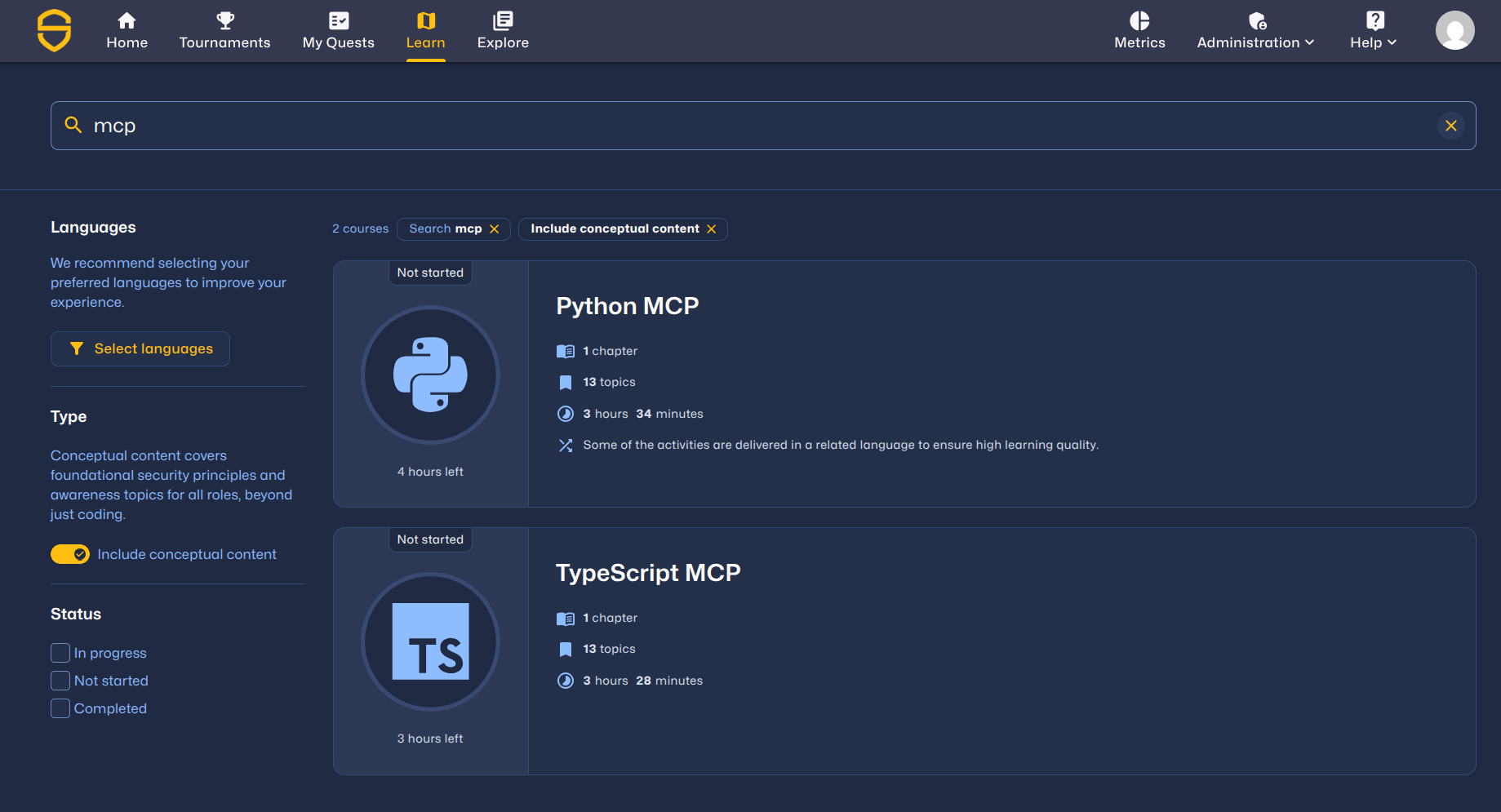
These learning pathways cover the majority of the developer-focused concepts reflected throughout the guidance and provide hands-on experience with MCP-specific security considerations, agent communication protocols, secure implementation practices, and AI-enabled development workflows.

For security leaders evaluating how to operationalize AI Software Governance, developer capability remains one of the most practical and measurable controls available. Governance policies establish expectations. Visibility helps identify risk. Developer capability helps reduce risk at its source.

Final Thoughts

The NSA doesn’t publish cybersecurity guidance for emerging protocols lightly. The fact that MCP warranted a dedicated document reflects where agentic development is heading and the real-world risk that comes with it.

Secure Code Warrior's MCP and AI security curriculum already covers many of the implementation practices and security considerations highlighted throughout the guidance. The guidance reinforces the importance of secure implementation, governance, and developer capability as foundational elements of responsible AI adoption.

MCP adoption is accelerating, and the security challenges that come with it are not theoretical. As MCP-enabled systems move into production, secure implementation, visibility, governance, and traceability become critical. Secure Code Warrior sits at the center of that — training developers as the tooling evolves, governing what AI agents touch in your repositories, and delivering the traceability compliance and incident response demands.

Secure Code Warrior branded blog hero image with the text "The NSA has entered the MCP conversation" overlaid on a blue background featuring the National Security Agency seal.
View Resource
View Resource

NSA published its first MCP security guidance. SCW's curriculum already covers 18 of 23 issues raised — here's how it maps.

Interested in more?

Shannon Holt is a cybersecurity product marketer with a background in application security, cloud security services, and compliance standards like PCI-DSS and HITRUST.

learn more

Secure Code Warrior is here for your organization to help you secure code across the entire software development lifecycle and create a culture in which cybersecurity is top of mind. Whether you’re an AppSec Manager, Developer, CISO, or anyone involved in security, we can help your organization reduce risks associated with insecure code.

Book a demo
Share on:
linkedin brandsSocialx logo
Author
Smiling woman with long wavy hair wearing a black top in a softly lit modern office.
Shannon Holt
Published Jun 11, 2026

Shannon Holt is a cybersecurity product marketer with a background in application security, cloud security services, and compliance standards like PCI-DSS and HITRUST.

Shannon Holt is a cybersecurity product marketer with a background in application security, cloud security services, and compliance standards like PCI-DSS and HITRUST. She’s passionate about making secure development and compliance more practical and approachable for technical teams, bridging the gap between security expectations and the realities of modern software development.

Share on:
linkedin brandsSocialx logo
Secure Code Warrior branded blog hero image with the text "The NSA has entered the MCP conversation" overlaid on a blue background featuring the National Security Agency seal.

The National Security Agency's Artificial Intelligence Security Center (AISC) recently published its first formal cybersecurity guidance for the Model Context Protocol (MCP): Model Context Protocol (MCP): Security Design Considerations for AI-Driven Automation. It covers access control, prompt handling, tool execution, agent permissions, auditability, and governance of third-party integrations. These are the core implementation concerns that come with building MCP servers and tools as production services.

As software development shifts from human-written code to AI-assisted workflows and fully agentic systems, the security of agent communication protocols is becoming a critical concern. These are areas Secure Code Warrior has been investing in for some time. In November 2025, Secure Code Warrior introduced one of the industry's first dedicated MCP security learning pathways, helping organizations prepare developers for the emerging risks associated with agent communication protocols, AI agents, and MCP-enabled workflows.

At the time, there was no publicly available OWASP MCP Top 10 and no formal government guidance focused specifically on MCP security. Our content team conducted extensive research into the emerging security challenges around MCP implementations and developed a curriculum to help developers build and use MCP securely in real-world production environments.

We’ve kept pace since. New NSA guidance, evolving OWASP MCP research, and real-world exploitation examples all feed into the curriculum as the threat landscape shifts. 

The publication of formal NSA guidance reinforces the importance of this work, and validates it. Of the 23 discrete security issues the NSA raises, Secure Code Warrior's curriculum provides direct coverage of 18. As organizations move from experimenting with agentic systems to actually running them, the gap between governance policy and implementation reality becomes a risk. Closing it requires developer capability. Frameworks alone won’t do it. 

The Role of Developer Capability

Read past the technical specifics of the NSA guidance and a consistent theme emerges: the security of MCP-enabled systems comes down to how they’re built. Access controls, trust boundaries, output validation, audit logging. None of these securely configures itself.

Validating inputs, constraining permissions, establishing trust boundaries, monitoring activity. The NSA’s recommendations are implementation-level. You can’t policy your way to them. They require developers who understand what they’re building, how it could be misused, and why it matters.

As organizations continue adopting AI-assisted and agentic development workflows, developer capability is one of the three things organizations need to get right in the agentic era. The other two: visibility into what AI is doing in your codebase, and governance guardrails on what it can touch. Secure Code Warrior addresses all three: Developer training, Trust Agent’s commit-level risk correlation, and the guardrails and traceability compliance teams actually need.

Secure Code Warrior Coverage for MCP Security

Secure Code Warrior's MCP and AI security curriculum was built for exactly this. Here’s how it maps.

The following content is available today and directly covers 18 of the 23 discrete security issues the NSA raises — across concerns, real-world examples, and recommendations. It helps organizations build developer capability across key areas of MCP security agent communication protocols, prompt handling, secure implementation practices, and AI-enabled development workflows.

NSA focus area SCW coverage
Agent communication security
Vulnerabilities in agents and their communication protocols
Agent communication protocols
Best practices for agent and communication protocol security
Prompt & output security
Direct prompt injection
Indirect prompt injection
Improper output handling
Agent behavior & control
Excessive agency
Unbounded consumption
Insecure plugin design
MCP secure coding
OS command injection
Code injection
Missing authentication
Credential expiration
Function level access control
Security misconfiguration
SSRF
Insufficient logging
Secure design & governance
LLM security design patterns
Supply chain vulnerabilities
Vulnerable components from untrusted source (MCP variant)
Improper assets management (MCP variant)

This isn’t coverage built to match the NSA document after the fact. Questions around agent communication security, prompt handling, access control, governance, and secure implementation are no longer theoretical concerns — and neither is our coverage of them. Our AI Agents curriculum addresses the same real-world attacks documented by the NSA, drawing on the same research sources, including the Invariantlabs WhatsApp MCP exploit and tool-poisoning studies. They are practical considerations for teams deploying AI-enabled systems today.

A note on gaps: The analysis reflects direct coverage across the majority of what the NSA raises. A small number of items (including MCP message-level cryptographic signing and cross-implementation behavioral divergence) represent areas where our content addresses the underlying principle but not the full depth the NSA recommends. These are on our curriculum roadmap.

Organizations that invest in developer education alongside governance and visibility initiatives are often better positioned to adopt emerging technologies securely and at scale. Developer capability is one part of the picture. Secure Code Warrior also helps organizations govern what AI agents can and can’t touch in their repositories, and provides the traceability compliance and incident response demand across the full development lifecycle.

Where Teams Can Start

Organizations looking to align developer education with the implementation practices highlighted throughout the NSA guidance can begin with Secure Code Warrior's Python-MCP Quest and TypeScript-MCP Quest pathways.

These learning pathways cover the majority of the developer-focused concepts reflected throughout the guidance and provide hands-on experience with MCP-specific security considerations, agent communication protocols, secure implementation practices, and AI-enabled development workflows.

For security leaders evaluating how to operationalize AI Software Governance, developer capability remains one of the most practical and measurable controls available. Governance policies establish expectations. Visibility helps identify risk. Developer capability helps reduce risk at its source.

Final Thoughts

The NSA doesn’t publish cybersecurity guidance for emerging protocols lightly. The fact that MCP warranted a dedicated document reflects where agentic development is heading and the real-world risk that comes with it.

Secure Code Warrior's MCP and AI security curriculum already covers many of the implementation practices and security considerations highlighted throughout the guidance. The guidance reinforces the importance of secure implementation, governance, and developer capability as foundational elements of responsible AI adoption.

MCP adoption is accelerating, and the security challenges that come with it are not theoretical. As MCP-enabled systems move into production, secure implementation, visibility, governance, and traceability become critical. Secure Code Warrior sits at the center of that — training developers as the tooling evolves, governing what AI agents touch in your repositories, and delivering the traceability compliance and incident response demands.

View Resource
View Resource

Fill out the form below to download the report

We would like your permission to send you information on our products and/or related secure coding topics. We’ll always treat your personal details with the utmost care and will never sell them to other companies for marketing purposes.

Submit
SCW Icons
scw error icon
To submit the form, please enable 'Analytics' cookies. Feel free to disable them again once you're done.
Secure Code Warrior branded blog hero image with the text "The NSA has entered the MCP conversation" overlaid on a blue background featuring the National Security Agency seal.

The National Security Agency's Artificial Intelligence Security Center (AISC) recently published its first formal cybersecurity guidance for the Model Context Protocol (MCP): Model Context Protocol (MCP): Security Design Considerations for AI-Driven Automation. It covers access control, prompt handling, tool execution, agent permissions, auditability, and governance of third-party integrations. These are the core implementation concerns that come with building MCP servers and tools as production services.

As software development shifts from human-written code to AI-assisted workflows and fully agentic systems, the security of agent communication protocols is becoming a critical concern. These are areas Secure Code Warrior has been investing in for some time. In November 2025, Secure Code Warrior introduced one of the industry's first dedicated MCP security learning pathways, helping organizations prepare developers for the emerging risks associated with agent communication protocols, AI agents, and MCP-enabled workflows.

At the time, there was no publicly available OWASP MCP Top 10 and no formal government guidance focused specifically on MCP security. Our content team conducted extensive research into the emerging security challenges around MCP implementations and developed a curriculum to help developers build and use MCP securely in real-world production environments.

We’ve kept pace since. New NSA guidance, evolving OWASP MCP research, and real-world exploitation examples all feed into the curriculum as the threat landscape shifts. 

The publication of formal NSA guidance reinforces the importance of this work, and validates it. Of the 23 discrete security issues the NSA raises, Secure Code Warrior's curriculum provides direct coverage of 18. As organizations move from experimenting with agentic systems to actually running them, the gap between governance policy and implementation reality becomes a risk. Closing it requires developer capability. Frameworks alone won’t do it. 

The Role of Developer Capability

Read past the technical specifics of the NSA guidance and a consistent theme emerges: the security of MCP-enabled systems comes down to how they’re built. Access controls, trust boundaries, output validation, audit logging. None of these securely configures itself.

Validating inputs, constraining permissions, establishing trust boundaries, monitoring activity. The NSA’s recommendations are implementation-level. You can’t policy your way to them. They require developers who understand what they’re building, how it could be misused, and why it matters.

As organizations continue adopting AI-assisted and agentic development workflows, developer capability is one of the three things organizations need to get right in the agentic era. The other two: visibility into what AI is doing in your codebase, and governance guardrails on what it can touch. Secure Code Warrior addresses all three: Developer training, Trust Agent’s commit-level risk correlation, and the guardrails and traceability compliance teams actually need.

Secure Code Warrior Coverage for MCP Security

Secure Code Warrior's MCP and AI security curriculum was built for exactly this. Here’s how it maps.

The following content is available today and directly covers 18 of the 23 discrete security issues the NSA raises — across concerns, real-world examples, and recommendations. It helps organizations build developer capability across key areas of MCP security agent communication protocols, prompt handling, secure implementation practices, and AI-enabled development workflows.

NSA focus area SCW coverage
Agent communication security
Vulnerabilities in agents and their communication protocols
Agent communication protocols
Best practices for agent and communication protocol security
Prompt & output security
Direct prompt injection
Indirect prompt injection
Improper output handling
Agent behavior & control
Excessive agency
Unbounded consumption
Insecure plugin design
MCP secure coding
OS command injection
Code injection
Missing authentication
Credential expiration
Function level access control
Security misconfiguration
SSRF
Insufficient logging
Secure design & governance
LLM security design patterns
Supply chain vulnerabilities
Vulnerable components from untrusted source (MCP variant)
Improper assets management (MCP variant)

This isn’t coverage built to match the NSA document after the fact. Questions around agent communication security, prompt handling, access control, governance, and secure implementation are no longer theoretical concerns — and neither is our coverage of them. Our AI Agents curriculum addresses the same real-world attacks documented by the NSA, drawing on the same research sources, including the Invariantlabs WhatsApp MCP exploit and tool-poisoning studies. They are practical considerations for teams deploying AI-enabled systems today.

A note on gaps: The analysis reflects direct coverage across the majority of what the NSA raises. A small number of items (including MCP message-level cryptographic signing and cross-implementation behavioral divergence) represent areas where our content addresses the underlying principle but not the full depth the NSA recommends. These are on our curriculum roadmap.

Organizations that invest in developer education alongside governance and visibility initiatives are often better positioned to adopt emerging technologies securely and at scale. Developer capability is one part of the picture. Secure Code Warrior also helps organizations govern what AI agents can and can’t touch in their repositories, and provides the traceability compliance and incident response demand across the full development lifecycle.

Where Teams Can Start

Organizations looking to align developer education with the implementation practices highlighted throughout the NSA guidance can begin with Secure Code Warrior's Python-MCP Quest and TypeScript-MCP Quest pathways.

These learning pathways cover the majority of the developer-focused concepts reflected throughout the guidance and provide hands-on experience with MCP-specific security considerations, agent communication protocols, secure implementation practices, and AI-enabled development workflows.

For security leaders evaluating how to operationalize AI Software Governance, developer capability remains one of the most practical and measurable controls available. Governance policies establish expectations. Visibility helps identify risk. Developer capability helps reduce risk at its source.

Final Thoughts

The NSA doesn’t publish cybersecurity guidance for emerging protocols lightly. The fact that MCP warranted a dedicated document reflects where agentic development is heading and the real-world risk that comes with it.

Secure Code Warrior's MCP and AI security curriculum already covers many of the implementation practices and security considerations highlighted throughout the guidance. The guidance reinforces the importance of secure implementation, governance, and developer capability as foundational elements of responsible AI adoption.

MCP adoption is accelerating, and the security challenges that come with it are not theoretical. As MCP-enabled systems move into production, secure implementation, visibility, governance, and traceability become critical. Secure Code Warrior sits at the center of that — training developers as the tooling evolves, governing what AI agents touch in your repositories, and delivering the traceability compliance and incident response demands.

View webinar
Get Started
learn more

Click on the link below and download the PDF of this resource.

Secure Code Warrior is here for your organization to help you secure code across the entire software development lifecycle and create a culture in which cybersecurity is top of mind. Whether you’re an AppSec Manager, Developer, CISO, or anyone involved in security, we can help your organization reduce risks associated with insecure code.

View reportBook a demo
View Resource
Share on:
linkedin brandsSocialx logo
Interested in more?

Share on:
linkedin brandsSocialx logo
Author
Smiling woman with long wavy hair wearing a black top in a softly lit modern office.
Shannon Holt
Published Jun 11, 2026

Shannon Holt is a cybersecurity product marketer with a background in application security, cloud security services, and compliance standards like PCI-DSS and HITRUST.

Shannon Holt is a cybersecurity product marketer with a background in application security, cloud security services, and compliance standards like PCI-DSS and HITRUST. She’s passionate about making secure development and compliance more practical and approachable for technical teams, bridging the gap between security expectations and the realities of modern software development.

Share on:
linkedin brandsSocialx logo

The National Security Agency's Artificial Intelligence Security Center (AISC) recently published its first formal cybersecurity guidance for the Model Context Protocol (MCP): Model Context Protocol (MCP): Security Design Considerations for AI-Driven Automation. It covers access control, prompt handling, tool execution, agent permissions, auditability, and governance of third-party integrations. These are the core implementation concerns that come with building MCP servers and tools as production services.

As software development shifts from human-written code to AI-assisted workflows and fully agentic systems, the security of agent communication protocols is becoming a critical concern. These are areas Secure Code Warrior has been investing in for some time. In November 2025, Secure Code Warrior introduced one of the industry's first dedicated MCP security learning pathways, helping organizations prepare developers for the emerging risks associated with agent communication protocols, AI agents, and MCP-enabled workflows.

At the time, there was no publicly available OWASP MCP Top 10 and no formal government guidance focused specifically on MCP security. Our content team conducted extensive research into the emerging security challenges around MCP implementations and developed a curriculum to help developers build and use MCP securely in real-world production environments.

We’ve kept pace since. New NSA guidance, evolving OWASP MCP research, and real-world exploitation examples all feed into the curriculum as the threat landscape shifts. 

The publication of formal NSA guidance reinforces the importance of this work, and validates it. Of the 23 discrete security issues the NSA raises, Secure Code Warrior's curriculum provides direct coverage of 18. As organizations move from experimenting with agentic systems to actually running them, the gap between governance policy and implementation reality becomes a risk. Closing it requires developer capability. Frameworks alone won’t do it. 

The Role of Developer Capability

Read past the technical specifics of the NSA guidance and a consistent theme emerges: the security of MCP-enabled systems comes down to how they’re built. Access controls, trust boundaries, output validation, audit logging. None of these securely configures itself.

Validating inputs, constraining permissions, establishing trust boundaries, monitoring activity. The NSA’s recommendations are implementation-level. You can’t policy your way to them. They require developers who understand what they’re building, how it could be misused, and why it matters.

As organizations continue adopting AI-assisted and agentic development workflows, developer capability is one of the three things organizations need to get right in the agentic era. The other two: visibility into what AI is doing in your codebase, and governance guardrails on what it can touch. Secure Code Warrior addresses all three: Developer training, Trust Agent’s commit-level risk correlation, and the guardrails and traceability compliance teams actually need.

Secure Code Warrior Coverage for MCP Security

Secure Code Warrior's MCP and AI security curriculum was built for exactly this. Here’s how it maps.

The following content is available today and directly covers 18 of the 23 discrete security issues the NSA raises — across concerns, real-world examples, and recommendations. It helps organizations build developer capability across key areas of MCP security agent communication protocols, prompt handling, secure implementation practices, and AI-enabled development workflows.

NSA focus area SCW coverage
Agent communication security
Vulnerabilities in agents and their communication protocols
Agent communication protocols
Best practices for agent and communication protocol security
Prompt & output security
Direct prompt injection
Indirect prompt injection
Improper output handling
Agent behavior & control
Excessive agency
Unbounded consumption
Insecure plugin design
MCP secure coding
OS command injection
Code injection
Missing authentication
Credential expiration
Function level access control
Security misconfiguration
SSRF
Insufficient logging
Secure design & governance
LLM security design patterns
Supply chain vulnerabilities
Vulnerable components from untrusted source (MCP variant)
Improper assets management (MCP variant)

This isn’t coverage built to match the NSA document after the fact. Questions around agent communication security, prompt handling, access control, governance, and secure implementation are no longer theoretical concerns — and neither is our coverage of them. Our AI Agents curriculum addresses the same real-world attacks documented by the NSA, drawing on the same research sources, including the Invariantlabs WhatsApp MCP exploit and tool-poisoning studies. They are practical considerations for teams deploying AI-enabled systems today.

A note on gaps: The analysis reflects direct coverage across the majority of what the NSA raises. A small number of items (including MCP message-level cryptographic signing and cross-implementation behavioral divergence) represent areas where our content addresses the underlying principle but not the full depth the NSA recommends. These are on our curriculum roadmap.

Organizations that invest in developer education alongside governance and visibility initiatives are often better positioned to adopt emerging technologies securely and at scale. Developer capability is one part of the picture. Secure Code Warrior also helps organizations govern what AI agents can and can’t touch in their repositories, and provides the traceability compliance and incident response demand across the full development lifecycle.

Where Teams Can Start

Organizations looking to align developer education with the implementation practices highlighted throughout the NSA guidance can begin with Secure Code Warrior's Python-MCP Quest and TypeScript-MCP Quest pathways.

These learning pathways cover the majority of the developer-focused concepts reflected throughout the guidance and provide hands-on experience with MCP-specific security considerations, agent communication protocols, secure implementation practices, and AI-enabled development workflows.

For security leaders evaluating how to operationalize AI Software Governance, developer capability remains one of the most practical and measurable controls available. Governance policies establish expectations. Visibility helps identify risk. Developer capability helps reduce risk at its source.

Final Thoughts

The NSA doesn’t publish cybersecurity guidance for emerging protocols lightly. The fact that MCP warranted a dedicated document reflects where agentic development is heading and the real-world risk that comes with it.

Secure Code Warrior's MCP and AI security curriculum already covers many of the implementation practices and security considerations highlighted throughout the guidance. The guidance reinforces the importance of secure implementation, governance, and developer capability as foundational elements of responsible AI adoption.

MCP adoption is accelerating, and the security challenges that come with it are not theoretical. As MCP-enabled systems move into production, secure implementation, visibility, governance, and traceability become critical. Secure Code Warrior sits at the center of that — training developers as the tooling evolves, governing what AI agents touch in your repositories, and delivering the traceability compliance and incident response demands.

Table of contents

Download PDF
View Resource
Interested in more?

Shannon Holt is a cybersecurity product marketer with a background in application security, cloud security services, and compliance standards like PCI-DSS and HITRUST.

learn more

Secure Code Warrior is here for your organization to help you secure code across the entire software development lifecycle and create a culture in which cybersecurity is top of mind. Whether you’re an AppSec Manager, Developer, CISO, or anyone involved in security, we can help your organization reduce risks associated with insecure code.

Book a demoDownload
Share on:
linkedin brandsSocialx logo
Resource hub

Resources to get you started

More posts
Resource hub

Resources to get you started

More posts