

全国网络安全宣传月:不仅仅是一次网络钓鱼探险


In this most festive of annual occasions for cybersecurity professionals, National Cybersecurity Awareness Month is a time many companies utilize to reflect on, and appraise, the general security awareness heartbeat across the organization. And with 62% of business experiencing a phishing or social engineering attack in 2018 alone, the importance of ensuring every individual in the business -- whether in a security role or not -- has adequate cybersecurity awareness training cannot be overstated.
As an increasingly global event, the month represents a catch-all for discussing best practices, and the initiatives are deliberately surface-level. However, even organizations with robust security programs and in-house specialists can use this time to assess the more technical teams for what they need to become more security-aware in the context of their role.
For AppSec specialists, development team leads, and the more security-savvy members of the engineering cohort, it might feel a bit like being taught how to suck eggs, but it is these champions within the business that can push security and safety to new heights, company-wide.
How to elevate your Cybersecurity Awareness Month
This is a golden opportunity for the security team to extend something of an olive branch to the development team, perhaps in the form of inter-team activities and programs that can help developers feel more positive about security in the context of their work.
Some kick-off ideas include:
- Help developers get the support they need to learn about secure coding. Not having the right tools for the job is a great way to feel justified in slam-dunking a task into the Too Hard Basket. If developers don't have the right training and tools to see security as a priority in the coding process, then it's no wonder so many teams are ill-equipped to keep common vulnerabilities out of their code.
Use this month to understand what is missing in the development tech stack, which managers can work together to improve communication and increase security visibility, and who can continue advocating for and championing security going forward. - Host a "Lunch and Learn'event. The cybersecurity and development communities are, in general, brimming with incredibly generous people who are only too happy to share their expertise. Reach out to conference speakers, tech peers in other companies, or even local OWASP chapters, and see who might be able to come in and chat with the team, or record a webinar with someone in the organization. It's a relatively quick win, and it can be a huge benefit for up-and-coming developers to see different security career pathways in front of them.
- Gather for some friendly competition. Learning about security is a lot more fun when you do something a little different and special. Secure coding tournaments are a great way to get developers testing their secure coding skills, and competing with their peers in a gamified environment. Get a fancy dress theme happening, and be creative with the teams (how about developers vs. their managers?). Order some pizza, drinks, get some energetic music pumping, and it can be an event to remember for the whole organization.
Giving back to the community: Download your free Secure Code Bootcamp app
I'm a developer myself, and it has always been the case that we search for what we can share and use for free. It's a point of pride to make some freeware that might help others, and this month is a good time to reflect on our roots and look at what we can provide to the community.
To that end, we're pleased to announce our new, free app, Secure Code Bootcamp. This is a pocket secure coding companion for coders who want to challenge themselves, progressively boosting their security awareness anywhere, anytime.
Download the app for iOS and Android now, and learn how to locate and identify OWASP vulnerabilities in Node.JS, Python:Django, Java:Spring, C# .NET: MVC:
Matias Madou, Ph.D. is a security expert, researcher, and CTO and co-founder of Secure Code Warrior. Matias obtained his Ph.D. in Application Security from Ghent University, focusing on static analysis solutions. He later joined Fortify in the US, where he realized that it was insufficient to solely detect code problems without aiding developers in writing secure code. This inspired him to develop products that assist developers, alleviate the burden of security, and exceed customers' expectations. When he is not at his desk as part of Team Awesome, he enjoys being on stage presenting at conferences including RSA Conference, BlackHat and DefCon.
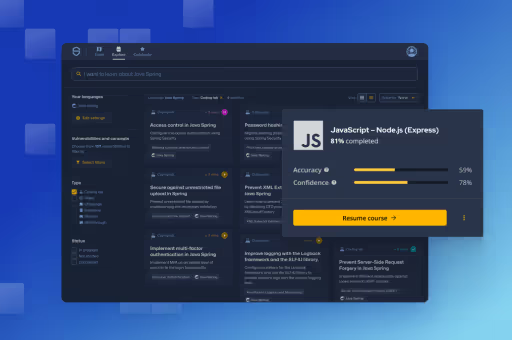
Secure Code Warrior可以帮助您的组织在整个软件开发生命周期中保护代码,并营造一种将网络安全放在首位的文化。无论您是 AppSec 经理、开发人员、首席信息安全官还是任何与安全相关的人,我们都可以帮助您的组织降低与不安全代码相关的风险。
预订演示


Matias Madou, Ph.D. is a security expert, researcher, and CTO and co-founder of Secure Code Warrior. Matias obtained his Ph.D. in Application Security from Ghent University, focusing on static analysis solutions. He later joined Fortify in the US, where he realized that it was insufficient to solely detect code problems without aiding developers in writing secure code. This inspired him to develop products that assist developers, alleviate the burden of security, and exceed customers' expectations. When he is not at his desk as part of Team Awesome, he enjoys being on stage presenting at conferences including RSA Conference, BlackHat and DefCon.
Matias is a researcher and developer with more than 15 years of hands-on software security experience. He has developed solutions for companies such as Fortify Software and his own company Sensei Security. Over his career, Matias has led multiple application security research projects which have led to commercial products and boasts over 10 patents under his belt. When he is away from his desk, Matias has served as an instructor for advanced application security training courses and regularly speaks at global conferences including RSA Conference, Black Hat, DefCon, BSIMM, OWASP AppSec and BruCon.
Matias holds a Ph.D. in Computer Engineering from Ghent University, where he studied application security through program obfuscation to hide the inner workings of an application.

In this most festive of annual occasions for cybersecurity professionals, National Cybersecurity Awareness Month is a time many companies utilize to reflect on, and appraise, the general security awareness heartbeat across the organization. And with 62% of business experiencing a phishing or social engineering attack in 2018 alone, the importance of ensuring every individual in the business -- whether in a security role or not -- has adequate cybersecurity awareness training cannot be overstated.
As an increasingly global event, the month represents a catch-all for discussing best practices, and the initiatives are deliberately surface-level. However, even organizations with robust security programs and in-house specialists can use this time to assess the more technical teams for what they need to become more security-aware in the context of their role.
For AppSec specialists, development team leads, and the more security-savvy members of the engineering cohort, it might feel a bit like being taught how to suck eggs, but it is these champions within the business that can push security and safety to new heights, company-wide.
How to elevate your Cybersecurity Awareness Month
This is a golden opportunity for the security team to extend something of an olive branch to the development team, perhaps in the form of inter-team activities and programs that can help developers feel more positive about security in the context of their work.
Some kick-off ideas include:
- Help developers get the support they need to learn about secure coding. Not having the right tools for the job is a great way to feel justified in slam-dunking a task into the Too Hard Basket. If developers don't have the right training and tools to see security as a priority in the coding process, then it's no wonder so many teams are ill-equipped to keep common vulnerabilities out of their code.
Use this month to understand what is missing in the development tech stack, which managers can work together to improve communication and increase security visibility, and who can continue advocating for and championing security going forward. - Host a "Lunch and Learn'event. The cybersecurity and development communities are, in general, brimming with incredibly generous people who are only too happy to share their expertise. Reach out to conference speakers, tech peers in other companies, or even local OWASP chapters, and see who might be able to come in and chat with the team, or record a webinar with someone in the organization. It's a relatively quick win, and it can be a huge benefit for up-and-coming developers to see different security career pathways in front of them.
- Gather for some friendly competition. Learning about security is a lot more fun when you do something a little different and special. Secure coding tournaments are a great way to get developers testing their secure coding skills, and competing with their peers in a gamified environment. Get a fancy dress theme happening, and be creative with the teams (how about developers vs. their managers?). Order some pizza, drinks, get some energetic music pumping, and it can be an event to remember for the whole organization.
Giving back to the community: Download your free Secure Code Bootcamp app
I'm a developer myself, and it has always been the case that we search for what we can share and use for free. It's a point of pride to make some freeware that might help others, and this month is a good time to reflect on our roots and look at what we can provide to the community.
To that end, we're pleased to announce our new, free app, Secure Code Bootcamp. This is a pocket secure coding companion for coders who want to challenge themselves, progressively boosting their security awareness anywhere, anytime.
Download the app for iOS and Android now, and learn how to locate and identify OWASP vulnerabilities in Node.JS, Python:Django, Java:Spring, C# .NET: MVC:


In this most festive of annual occasions for cybersecurity professionals, National Cybersecurity Awareness Month is a time many companies utilize to reflect on, and appraise, the general security awareness heartbeat across the organization. And with 62% of business experiencing a phishing or social engineering attack in 2018 alone, the importance of ensuring every individual in the business -- whether in a security role or not -- has adequate cybersecurity awareness training cannot be overstated.
As an increasingly global event, the month represents a catch-all for discussing best practices, and the initiatives are deliberately surface-level. However, even organizations with robust security programs and in-house specialists can use this time to assess the more technical teams for what they need to become more security-aware in the context of their role.
For AppSec specialists, development team leads, and the more security-savvy members of the engineering cohort, it might feel a bit like being taught how to suck eggs, but it is these champions within the business that can push security and safety to new heights, company-wide.
How to elevate your Cybersecurity Awareness Month
This is a golden opportunity for the security team to extend something of an olive branch to the development team, perhaps in the form of inter-team activities and programs that can help developers feel more positive about security in the context of their work.
Some kick-off ideas include:
- Help developers get the support they need to learn about secure coding. Not having the right tools for the job is a great way to feel justified in slam-dunking a task into the Too Hard Basket. If developers don't have the right training and tools to see security as a priority in the coding process, then it's no wonder so many teams are ill-equipped to keep common vulnerabilities out of their code.
Use this month to understand what is missing in the development tech stack, which managers can work together to improve communication and increase security visibility, and who can continue advocating for and championing security going forward. - Host a "Lunch and Learn'event. The cybersecurity and development communities are, in general, brimming with incredibly generous people who are only too happy to share their expertise. Reach out to conference speakers, tech peers in other companies, or even local OWASP chapters, and see who might be able to come in and chat with the team, or record a webinar with someone in the organization. It's a relatively quick win, and it can be a huge benefit for up-and-coming developers to see different security career pathways in front of them.
- Gather for some friendly competition. Learning about security is a lot more fun when you do something a little different and special. Secure coding tournaments are a great way to get developers testing their secure coding skills, and competing with their peers in a gamified environment. Get a fancy dress theme happening, and be creative with the teams (how about developers vs. their managers?). Order some pizza, drinks, get some energetic music pumping, and it can be an event to remember for the whole organization.
Giving back to the community: Download your free Secure Code Bootcamp app
I'm a developer myself, and it has always been the case that we search for what we can share and use for free. It's a point of pride to make some freeware that might help others, and this month is a good time to reflect on our roots and look at what we can provide to the community.
To that end, we're pleased to announce our new, free app, Secure Code Bootcamp. This is a pocket secure coding companion for coders who want to challenge themselves, progressively boosting their security awareness anywhere, anytime.
Download the app for iOS and Android now, and learn how to locate and identify OWASP vulnerabilities in Node.JS, Python:Django, Java:Spring, C# .NET: MVC:
点击下面的链接并下载此资源的PDF。
Secure Code Warrior可以帮助您的组织在整个软件开发生命周期中保护代码,并营造一种将网络安全放在首位的文化。无论您是 AppSec 经理、开发人员、首席信息安全官还是任何与安全相关的人,我们都可以帮助您的组织降低与不安全代码相关的风险。
查看报告预订演示
Matias Madou, Ph.D. is a security expert, researcher, and CTO and co-founder of Secure Code Warrior. Matias obtained his Ph.D. in Application Security from Ghent University, focusing on static analysis solutions. He later joined Fortify in the US, where he realized that it was insufficient to solely detect code problems without aiding developers in writing secure code. This inspired him to develop products that assist developers, alleviate the burden of security, and exceed customers' expectations. When he is not at his desk as part of Team Awesome, he enjoys being on stage presenting at conferences including RSA Conference, BlackHat and DefCon.
Matias is a researcher and developer with more than 15 years of hands-on software security experience. He has developed solutions for companies such as Fortify Software and his own company Sensei Security. Over his career, Matias has led multiple application security research projects which have led to commercial products and boasts over 10 patents under his belt. When he is away from his desk, Matias has served as an instructor for advanced application security training courses and regularly speaks at global conferences including RSA Conference, Black Hat, DefCon, BSIMM, OWASP AppSec and BruCon.
Matias holds a Ph.D. in Computer Engineering from Ghent University, where he studied application security through program obfuscation to hide the inner workings of an application.
In this most festive of annual occasions for cybersecurity professionals, National Cybersecurity Awareness Month is a time many companies utilize to reflect on, and appraise, the general security awareness heartbeat across the organization. And with 62% of business experiencing a phishing or social engineering attack in 2018 alone, the importance of ensuring every individual in the business -- whether in a security role or not -- has adequate cybersecurity awareness training cannot be overstated.
As an increasingly global event, the month represents a catch-all for discussing best practices, and the initiatives are deliberately surface-level. However, even organizations with robust security programs and in-house specialists can use this time to assess the more technical teams for what they need to become more security-aware in the context of their role.
For AppSec specialists, development team leads, and the more security-savvy members of the engineering cohort, it might feel a bit like being taught how to suck eggs, but it is these champions within the business that can push security and safety to new heights, company-wide.
How to elevate your Cybersecurity Awareness Month
This is a golden opportunity for the security team to extend something of an olive branch to the development team, perhaps in the form of inter-team activities and programs that can help developers feel more positive about security in the context of their work.
Some kick-off ideas include:
- Help developers get the support they need to learn about secure coding. Not having the right tools for the job is a great way to feel justified in slam-dunking a task into the Too Hard Basket. If developers don't have the right training and tools to see security as a priority in the coding process, then it's no wonder so many teams are ill-equipped to keep common vulnerabilities out of their code.
Use this month to understand what is missing in the development tech stack, which managers can work together to improve communication and increase security visibility, and who can continue advocating for and championing security going forward. - Host a "Lunch and Learn'event. The cybersecurity and development communities are, in general, brimming with incredibly generous people who are only too happy to share their expertise. Reach out to conference speakers, tech peers in other companies, or even local OWASP chapters, and see who might be able to come in and chat with the team, or record a webinar with someone in the organization. It's a relatively quick win, and it can be a huge benefit for up-and-coming developers to see different security career pathways in front of them.
- Gather for some friendly competition. Learning about security is a lot more fun when you do something a little different and special. Secure coding tournaments are a great way to get developers testing their secure coding skills, and competing with their peers in a gamified environment. Get a fancy dress theme happening, and be creative with the teams (how about developers vs. their managers?). Order some pizza, drinks, get some energetic music pumping, and it can be an event to remember for the whole organization.
Giving back to the community: Download your free Secure Code Bootcamp app
I'm a developer myself, and it has always been the case that we search for what we can share and use for free. It's a point of pride to make some freeware that might help others, and this month is a good time to reflect on our roots and look at what we can provide to the community.
To that end, we're pleased to announce our new, free app, Secure Code Bootcamp. This is a pocket secure coding companion for coders who want to challenge themselves, progressively boosting their security awareness anywhere, anytime.
Download the app for iOS and Android now, and learn how to locate and identify OWASP vulnerabilities in Node.JS, Python:Django, Java:Spring, C# .NET: MVC:
目录
Matias Madou, Ph.D. is a security expert, researcher, and CTO and co-founder of Secure Code Warrior. Matias obtained his Ph.D. in Application Security from Ghent University, focusing on static analysis solutions. He later joined Fortify in the US, where he realized that it was insufficient to solely detect code problems without aiding developers in writing secure code. This inspired him to develop products that assist developers, alleviate the burden of security, and exceed customers' expectations. When he is not at his desk as part of Team Awesome, he enjoys being on stage presenting at conferences including RSA Conference, BlackHat and DefCon.
Secure Code Warrior可以帮助您的组织在整个软件开发生命周期中保护代码,并营造一种将网络安全放在首位的文化。无论您是 AppSec 经理、开发人员、首席信息安全官还是任何与安全相关的人,我们都可以帮助您的组织降低与不安全代码相关的风险。
预订演示下载帮助您入门的资源


帮助您入门的资源


Secure coding learning that reflects real AI usage
Align secure coding training to real AI development activity — automatically assigning guidance to developers using AI tools, without manual intervention.Align secure coding training to real AI development activity — automatically assigning guidance to developers using AI tools, without manual intervention.
Train developers on the real risks in their code, whether human-written or AI-generated
Adaptive Learning auto-assigns targeted secure coding training to the developers introducing real vulnerabilities, reducing recurring risks at the source.Secure Code Warrior blog banner with a blue overlay over a developer working at a multi-monitor desk displaying code, alongside the headline 'Train developers on the real risks in their code.'l