

Announcing Adaptive Learning: The Antidote to AI Software Security Risk and Skill Gaps


Having trouble keeping up with the hypersonic movement of the AI industry? You’re not alone. If you ask me, we’re currently in the first stages of the “pain period” if you’re on the security side of things; after all, it’s not every day that something like Claude Mythos is released to give security leaders the migraine of a lifetime.
However, this is not the time to panic, get caught up in headline hype, or, most importantly, fail to prepare for one of the most significant evolutions in software development we will see in our lifetimes.
This transformation might be driving “unprecedented” (there’s that word again) innovation, but it is also introducing code churn at an alarming rate, with the ratio of deleted to added lines in merged code increasing by 861% each quarter amid high AI adoption, according to Faros’ 2026 AI Engineering Report. Additionally, source code has now become the most common data type submitted to unauthorized external AI models, posing a serious risk of intellectual property exposure.
The downstream consequences are measurable and severe. Exploitation of vulnerabilities has overtaken credential abuse as the leading breach method, accounting for 31% of initial access vectors (this stat, along with other concerning data points, can be found in the 2026 Verizon Data Breach Investigations Report). To protect the AI roadmaps that enterprises are betting their futures on, risk reduction must move further upstream. That is exactly why Secure Code Warrior unveiled our new Adaptive Learning capability at the 2026 Gartner® Security & Risk Management Summit.
As I noted during our launch, enterprises today are trying to achieve three primary objectives at every stage of development. First, developers and agents must learn to build securely. Second, businesses must govern what AI can and can’t touch in the codebase. Third, security teams must be able to trace which AI did what, where, and for whom. With SCW’s Adaptive Learning, organizations and developers can swiftly move from merely understanding risk to actively reducing it at scale, with measurable proof at the commit level. This is absolutely imperative as developers transition from traditional workflows into environments where they act as orchestrators of autonomous agents.
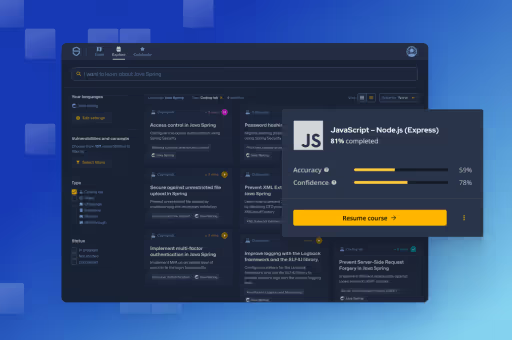
Adaptive Learning bridges SCW Trust Agent with our entire learning platform, ensuring training stays perfectly aligned with real-time developer activity.
By utilizing AI Signals, we detect the specific AI tools developers use, down to the lines of code they commit, automatically triggering personalized training tailored to their exact actions. Simultaneously, Vulnerability Signals connect your existing security tools directly to developer learning, identifying real vulnerabilities in active repositories and building the secure coding habits necessary to keep flaws out of production. Ultimately, this generates auditable, per-developer evidence of AI security training that supports compliance with the EU AI Act, ISO/IEC 42001, and the NIST AI Risk Management Framework.
As we look toward the immediate future, the impending integration of highly advanced, hyper-autonomous models like Claude Mythos presents a paradigm-shifting capability that could easily spiral into a disaster if an enterprise's security leaders are unprepared. Unleashing an agent as powerful as Mythos in a corporate environment without strict guardrails - whether deliberate or via the hands of a bad actor - risks the widespread proliferation of vulnerabilities and unauthorized manipulation of the codebase at machine speed. This is where SCW’s suite of AI software governance tools can serve as a vital safety net.
By combining deep visibility into AI actions, strict policy enforcement on what AI can access, and Adaptive Learning to immediately upskill developers when a high-end agent generates risky code, SCW can walk beside you and prevent a potential crisis.
Adaptive Learning bridges SCW Trust Agent with our entire learning platform, ensuring training stays perfectly aligned with real-time developer activity.
Chief Executive Officer, Chairman, and Co-Founder
Secure Code Warrior可以帮助您的组织在整个软件开发生命周期中保护代码,并营造一种将网络安全放在首位的文化。无论您是 AppSec 经理、开发人员、首席信息安全官还是任何与安全相关的人,我们都可以帮助您的组织降低与不安全代码相关的风险。
预订演示


Chief Executive Officer, Chairman, and Co-Founder
Pieter Danhieux is a globally recognized security expert, with over 12 years experience as a security consultant and 8 years as a Principal Instructor for SANS teaching offensive techniques on how to target and assess organizations, systems and individuals for security weaknesses. In 2016, he was recognized as one of the Coolest Tech people in Australia (Business Insider), awarded Cyber Security Professional of the Year (AISA - Australian Information Security Association) and holds GSE, CISSP, GCIH, GCFA, GSEC, GPEN, GWAPT, GCIA certifications.
Having trouble keeping up with the hypersonic movement of the AI industry? You’re not alone. If you ask me, we’re currently in the first stages of the “pain period” if you’re on the security side of things; after all, it’s not every day that something like Claude Mythos is released to give security leaders the migraine of a lifetime.
However, this is not the time to panic, get caught up in headline hype, or, most importantly, fail to prepare for one of the most significant evolutions in software development we will see in our lifetimes.
This transformation might be driving “unprecedented” (there’s that word again) innovation, but it is also introducing code churn at an alarming rate, with the ratio of deleted to added lines in merged code increasing by 861% each quarter amid high AI adoption, according to Faros’ 2026 AI Engineering Report. Additionally, source code has now become the most common data type submitted to unauthorized external AI models, posing a serious risk of intellectual property exposure.
The downstream consequences are measurable and severe. Exploitation of vulnerabilities has overtaken credential abuse as the leading breach method, accounting for 31% of initial access vectors (this stat, along with other concerning data points, can be found in the 2026 Verizon Data Breach Investigations Report). To protect the AI roadmaps that enterprises are betting their futures on, risk reduction must move further upstream. That is exactly why Secure Code Warrior unveiled our new Adaptive Learning capability at the 2026 Gartner® Security & Risk Management Summit.
As I noted during our launch, enterprises today are trying to achieve three primary objectives at every stage of development. First, developers and agents must learn to build securely. Second, businesses must govern what AI can and can’t touch in the codebase. Third, security teams must be able to trace which AI did what, where, and for whom. With SCW’s Adaptive Learning, organizations and developers can swiftly move from merely understanding risk to actively reducing it at scale, with measurable proof at the commit level. This is absolutely imperative as developers transition from traditional workflows into environments where they act as orchestrators of autonomous agents.
Adaptive Learning bridges SCW Trust Agent with our entire learning platform, ensuring training stays perfectly aligned with real-time developer activity.
By utilizing AI Signals, we detect the specific AI tools developers use, down to the lines of code they commit, automatically triggering personalized training tailored to their exact actions. Simultaneously, Vulnerability Signals connect your existing security tools directly to developer learning, identifying real vulnerabilities in active repositories and building the secure coding habits necessary to keep flaws out of production. Ultimately, this generates auditable, per-developer evidence of AI security training that supports compliance with the EU AI Act, ISO/IEC 42001, and the NIST AI Risk Management Framework.
As we look toward the immediate future, the impending integration of highly advanced, hyper-autonomous models like Claude Mythos presents a paradigm-shifting capability that could easily spiral into a disaster if an enterprise's security leaders are unprepared. Unleashing an agent as powerful as Mythos in a corporate environment without strict guardrails - whether deliberate or via the hands of a bad actor - risks the widespread proliferation of vulnerabilities and unauthorized manipulation of the codebase at machine speed. This is where SCW’s suite of AI software governance tools can serve as a vital safety net.
By combining deep visibility into AI actions, strict policy enforcement on what AI can access, and Adaptive Learning to immediately upskill developers when a high-end agent generates risky code, SCW can walk beside you and prevent a potential crisis.


Having trouble keeping up with the hypersonic movement of the AI industry? You’re not alone. If you ask me, we’re currently in the first stages of the “pain period” if you’re on the security side of things; after all, it’s not every day that something like Claude Mythos is released to give security leaders the migraine of a lifetime.
However, this is not the time to panic, get caught up in headline hype, or, most importantly, fail to prepare for one of the most significant evolutions in software development we will see in our lifetimes.
This transformation might be driving “unprecedented” (there’s that word again) innovation, but it is also introducing code churn at an alarming rate, with the ratio of deleted to added lines in merged code increasing by 861% each quarter amid high AI adoption, according to Faros’ 2026 AI Engineering Report. Additionally, source code has now become the most common data type submitted to unauthorized external AI models, posing a serious risk of intellectual property exposure.
The downstream consequences are measurable and severe. Exploitation of vulnerabilities has overtaken credential abuse as the leading breach method, accounting for 31% of initial access vectors (this stat, along with other concerning data points, can be found in the 2026 Verizon Data Breach Investigations Report). To protect the AI roadmaps that enterprises are betting their futures on, risk reduction must move further upstream. That is exactly why Secure Code Warrior unveiled our new Adaptive Learning capability at the 2026 Gartner® Security & Risk Management Summit.
As I noted during our launch, enterprises today are trying to achieve three primary objectives at every stage of development. First, developers and agents must learn to build securely. Second, businesses must govern what AI can and can’t touch in the codebase. Third, security teams must be able to trace which AI did what, where, and for whom. With SCW’s Adaptive Learning, organizations and developers can swiftly move from merely understanding risk to actively reducing it at scale, with measurable proof at the commit level. This is absolutely imperative as developers transition from traditional workflows into environments where they act as orchestrators of autonomous agents.
Adaptive Learning bridges SCW Trust Agent with our entire learning platform, ensuring training stays perfectly aligned with real-time developer activity.
By utilizing AI Signals, we detect the specific AI tools developers use, down to the lines of code they commit, automatically triggering personalized training tailored to their exact actions. Simultaneously, Vulnerability Signals connect your existing security tools directly to developer learning, identifying real vulnerabilities in active repositories and building the secure coding habits necessary to keep flaws out of production. Ultimately, this generates auditable, per-developer evidence of AI security training that supports compliance with the EU AI Act, ISO/IEC 42001, and the NIST AI Risk Management Framework.
As we look toward the immediate future, the impending integration of highly advanced, hyper-autonomous models like Claude Mythos presents a paradigm-shifting capability that could easily spiral into a disaster if an enterprise's security leaders are unprepared. Unleashing an agent as powerful as Mythos in a corporate environment without strict guardrails - whether deliberate or via the hands of a bad actor - risks the widespread proliferation of vulnerabilities and unauthorized manipulation of the codebase at machine speed. This is where SCW’s suite of AI software governance tools can serve as a vital safety net.
By combining deep visibility into AI actions, strict policy enforcement on what AI can access, and Adaptive Learning to immediately upskill developers when a high-end agent generates risky code, SCW can walk beside you and prevent a potential crisis.
点击下面的链接并下载此资源的PDF。
Secure Code Warrior可以帮助您的组织在整个软件开发生命周期中保护代码,并营造一种将网络安全放在首位的文化。无论您是 AppSec 经理、开发人员、首席信息安全官还是任何与安全相关的人,我们都可以帮助您的组织降低与不安全代码相关的风险。
查看报告预订演示
Chief Executive Officer, Chairman, and Co-Founder
Pieter Danhieux is a globally recognized security expert, with over 12 years experience as a security consultant and 8 years as a Principal Instructor for SANS teaching offensive techniques on how to target and assess organizations, systems and individuals for security weaknesses. In 2016, he was recognized as one of the Coolest Tech people in Australia (Business Insider), awarded Cyber Security Professional of the Year (AISA - Australian Information Security Association) and holds GSE, CISSP, GCIH, GCFA, GSEC, GPEN, GWAPT, GCIA certifications.
Having trouble keeping up with the hypersonic movement of the AI industry? You’re not alone. If you ask me, we’re currently in the first stages of the “pain period” if you’re on the security side of things; after all, it’s not every day that something like Claude Mythos is released to give security leaders the migraine of a lifetime.
However, this is not the time to panic, get caught up in headline hype, or, most importantly, fail to prepare for one of the most significant evolutions in software development we will see in our lifetimes.
This transformation might be driving “unprecedented” (there’s that word again) innovation, but it is also introducing code churn at an alarming rate, with the ratio of deleted to added lines in merged code increasing by 861% each quarter amid high AI adoption, according to Faros’ 2026 AI Engineering Report. Additionally, source code has now become the most common data type submitted to unauthorized external AI models, posing a serious risk of intellectual property exposure.
The downstream consequences are measurable and severe. Exploitation of vulnerabilities has overtaken credential abuse as the leading breach method, accounting for 31% of initial access vectors (this stat, along with other concerning data points, can be found in the 2026 Verizon Data Breach Investigations Report). To protect the AI roadmaps that enterprises are betting their futures on, risk reduction must move further upstream. That is exactly why Secure Code Warrior unveiled our new Adaptive Learning capability at the 2026 Gartner® Security & Risk Management Summit.
As I noted during our launch, enterprises today are trying to achieve three primary objectives at every stage of development. First, developers and agents must learn to build securely. Second, businesses must govern what AI can and can’t touch in the codebase. Third, security teams must be able to trace which AI did what, where, and for whom. With SCW’s Adaptive Learning, organizations and developers can swiftly move from merely understanding risk to actively reducing it at scale, with measurable proof at the commit level. This is absolutely imperative as developers transition from traditional workflows into environments where they act as orchestrators of autonomous agents.
Adaptive Learning bridges SCW Trust Agent with our entire learning platform, ensuring training stays perfectly aligned with real-time developer activity.
By utilizing AI Signals, we detect the specific AI tools developers use, down to the lines of code they commit, automatically triggering personalized training tailored to their exact actions. Simultaneously, Vulnerability Signals connect your existing security tools directly to developer learning, identifying real vulnerabilities in active repositories and building the secure coding habits necessary to keep flaws out of production. Ultimately, this generates auditable, per-developer evidence of AI security training that supports compliance with the EU AI Act, ISO/IEC 42001, and the NIST AI Risk Management Framework.
As we look toward the immediate future, the impending integration of highly advanced, hyper-autonomous models like Claude Mythos presents a paradigm-shifting capability that could easily spiral into a disaster if an enterprise's security leaders are unprepared. Unleashing an agent as powerful as Mythos in a corporate environment without strict guardrails - whether deliberate or via the hands of a bad actor - risks the widespread proliferation of vulnerabilities and unauthorized manipulation of the codebase at machine speed. This is where SCW’s suite of AI software governance tools can serve as a vital safety net.
By combining deep visibility into AI actions, strict policy enforcement on what AI can access, and Adaptive Learning to immediately upskill developers when a high-end agent generates risky code, SCW can walk beside you and prevent a potential crisis.
帮助您入门的资源




Trust Agent:AI - Secure and scale AI-Drive development
AI is writing code. Who’s governing it? With up to 50% of AI-generated code containing security weaknesses, managing AI risk is critical. Discover how SCW's Trust Agent: AI provides the real-time visibility, proactive governance, and targeted upskilling needed to scale AI-driven development securely.
帮助您入门的资源
Secure coding learning that reflects real AI usage
Align secure coding training to real AI development activity — automatically assigning guidance to developers using AI tools, without manual intervention.Align secure coding training to real AI development activity — automatically assigning guidance to developers using AI tools, without manual intervention.
Train developers on the real risks in their code, whether human-written or AI-generated
Adaptive Learning auto-assigns targeted secure coding training to the developers introducing real vulnerabilities, reducing recurring risks at the source.Secure Code Warrior blog banner with a blue overlay over a developer working at a multi-monitor desk displaying code, alongside the headline 'Train developers on the real risks in their code.'l
Securing the Future of Software: Why Secure Code Warrior and KnowBe4 Are Joining Forces
I am thrilled to announce today an upcoming strategic partnership between Secure Code Warrior and KnowBe4. KnowBe4 is a world-renowned leader in comprehensively managing human and agentic AI risk, making them the perfect partner to help us distribute foundational security awareness to organizations across the globe.

Post-Quantum Cryptography: Quantum Computers Will Break Today’s Encryption – Are You Ready?
Post-quantum cryptography (PQC) is critical for protecting data from quantum computing threats. Learn how “harvest now, decrypt later” exposes risk and how developers can prepare for quantum-safe security.