Technique de codage sécurisé : suppression sécurisée de fichiers
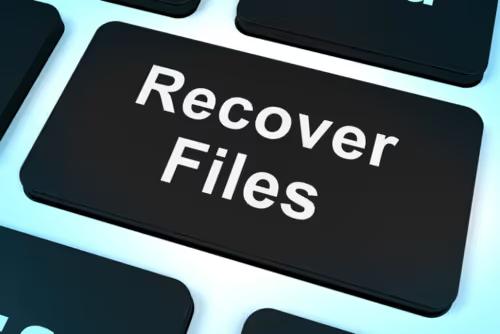
Supprimer des fichiers sur un système informatique est délicat. Tout le monde, même votre mère, a déjà supprimé un fichier par erreur et a été soulagé de le retrouver dans la corbeille pour pouvoir le récupérer.
Dans les systèmes informatiques, les données sont représentées par une séquence de bits. Le système doit donc effectuer un suivi au sein du système de fichiers pour savoir quels bits correspondent à quel fichier. Ces informations incluent la taille du fichier, sa date de dernière modification, son propriétaire, les droits d'accès, etc. Ces données de suivi sont stockées séparément du contenu du fichier.
Généralement, lorsqu'un fichier est supprimé, les bits qui le composent ne sont pas modifiés, mais les données de suivi sont mises à jour pour indiquer au système que cet espace de stockage est désormais libre et peut être réutilisé. Tant qu'un autre fichier n'est pas enregistré à cet emplacement et que les bits n'ont pas été écrasés, il est souvent possible de récupérer les données initiales. Cela permet non seulement d'accélérer la suppression des fichiers, mais constitue également une fonctionnalité utile pour annuler une suppression.
Cette approche présente toutefois des inconvénients. Lorsqu'une application manipule des informations sensibles, elle les enregistre quelque part sur le système de fichiers. Lorsque ces informations ne sont plus nécessaires, elles peuvent être supprimées. Si aucune précaution particulière n'est prise, ces données peuvent rester récupérables, même si le développeur avait l'intention de les effacer totalement.
Le moyen le plus simple d'effacer complètement ces données consiste à réécrire le contenu du fichier avec des données aléatoires (parfois même à plusieurs reprises). Il existe plusieurs méthodes de suppression sécurisée, qui varient selon les types de stockage et les systèmes de fichiers, comme la méthode Gutmann. Cependant, pour une utilisation quotidienne, ces méthodes sont souvent excessives et vous pouvez simplement écraser les données vous-même.
Soyez toutefois prudent ! N'utilisez pas uniquement des zéros ou d'autres données à faible entropie. De nombreux systèmes de fichiers peuvent optimiser l'écriture de tels fichiers creux et conserver une partie du contenu original. Il est recommandé de générer des données aléatoires sécurisées pour écraser l'intégralité du contenu du fichier avant de le supprimer.
La rémanence des données est la représentation physique résiduelle de données ayant été effacées d'une manière ou d'une autre. Une fois le support de stockage effacé, certaines caractéristiques physiques peuvent encore permettre la reconstruction des données.
Gouvernez le développement assisté par IA avant la mise en production
Évaluez les risques liés à l'IA, appliquez des politiques de codage sécurisé dès le commit et accélérez la livraison sécurisée tout au long de votre cycle de développement.
Explorer plus d'articles
Accédez à du contenu expert sur le codage sécurisé, la gouvernance de l'IA et la gestion des risques logiciels.
%252520%252520(3).avif)
Supercharged Security Awareness: How Tournaments are Inspiring Developers at Erste Group
Lorem ipsum dolor sit amet, consectetur adipiscing elit. Suspendisse varius enim in eros elementum tristique. Duis cursus, mi quis viverra ornare, eros dolor interdum nulla, ut commodo diam libero vitae erat. Aenean faucibus nibh et justo cursus id rutrum lorem imperdiet. Nunc ut sem vitae risus tristique posuere.

Security as culture: How Blue Prism cultivates world-class secure developers
Learn how Blue Prism, the global leader in intelligent automation for the enterprise, used Secure Code Warrior's agile learning platform to create a security-first culture with their developers, achieve their business goals, and ship secure code at speed

Une culture de la sécurité : comment Sage a bâti son programme de champions
Découvrez comment Sage a renforcé sa sécurité grâce à une approche flexible axée sur les relations humaines, formant plus de 200 champions de la sécurité et obtenant une réduction mesurable des risques.
Mois de la sensibilisation à la cybersécurité 2026 : comprendre la sécurité de l'IA est essentiel à la défense de l'entreprise
Nous avons atteint un point où la plupart des grandes entreprises d'IA ont publiquement appelé à un ralentissement mondial du développement de l'IA afin de permettre aux garde-fous de sécurité de rattraper leur retard. Pourtant, la réalité est que de graves problèmes de sécurité se sont déjà concrétisés. Cela place d'innombrables responsables de la sécurité et équipes de direction dans une situation d'urgence, alors que les coûts financiers et les risques liés à la mise en œuvre de l'IA ne cessent de s'accumuler.
Levier 8 : Valoriser votre programme
Un programme de codage sécurisé a besoin de plus qu'un contenu de qualité pour réussir. Le levier 8 montre comment l'image de marque transforme la participation en une expérience convoitée, axée sur le statut.
.avif)
Chaque employé est désormais en première ligne de la cybersécurité IA
Le paysage technologique des entreprises évolue à une vitesse que peu avaient anticipée avant qu'il ne soit trop tard. Nous avons officiellement franchi le cap du code écrit par l'humain et de l'assistance basique par copilote pour entrer dans l'ère du cycle de vie de développement agentique (ADLC). Si les agents IA autonomes promettent une efficacité sans précédent dans de multiples fonctions, ils apportent également une toute nouvelle catégorie de risques en matière de sécurité et de réglementation.
Sécurisez le développement piloté par l'IA avant le déploiement
Identifiez les risques de développement, appliquez vos politiques et prévenez les vulnérabilités tout au long du cycle de vie de vos logiciels.