
















The SCW AI Adoption Model™

A practical framework for governing secure AI development — at every stage, for every team.

Book a demo
Este es un texto dentro de un bloque div.
The problem

AI adoption is outpacing governance

AI is reshaping how software is created across entire organizations. But most enterprises lack visibility into how AI contributes to production code, who is using it, and whether it is secure. Gartner's 2026 Hype Cycle for Secure Software Engineering warns that AI-augmented development is expanding the attack surface faster than traditional controls can scale — and that AI coding tools are making secure coding skills more important than ever.


Four questions CISOs cannot answer today:
Which AI models create production code
If AI-assisted code meets security policy
Whether contributors are trained properly
Whether AI usage aligns to governance standards

The SDLC was built for human-authored code. It was not built for AI agents generating thousands of lines without review. As autonomy increases, invisible security debt accumulates — and CISOs are left unable to answer the questions that matter most.

The model

The SCW AI Adoption Model™

The SCW AI adoption model maps the full progression of AI use in software development across eight stages and three phases — from minimal AI assistance to fully autonomous agentic orchestration. It gives CISOs a practical framework to identify where their organization sits today, what training developers need at each stage, and which governance controls are required as autonomy increases.

Download whitepaper
Phase one
AI-Assisted

AI-Assisted

Retain full oversight

AI supports development but humans remain the primary authors. Developers write code, review AI suggestions, and retain full oversight of output. This is the ideal time to build a governance foundation before oversight degrades.

Phase two
AI-Native

AI-Native

Human oversight begins to deteriorate

Deliver advanced AppSec expertise, tailored governance design, and transformation planning for secure development programs.

Phase three
Agentic

Agentic

High-risk escalation points

Autonomous agents direct other agents across the full development lifecycle. Human involvement is reserved for high-risk escalation points. Governance must be entirely policy-driven. The SDLC is giving way to the Agentic Development Lifecycle.

The SCW AI Adoption Model™

Security responsibilities evolve with AI adoption

Explore the eight stages of AI adoption and the security capabilities required to build secure software at each stage — with 200+ security concepts and vulnerability categories mapped across the journey.

Book a demo
STAGE 1
AI-ASSISTED

Minimal AI use

Developers primarily write code themselves and apply secure coding fundamentals.

Key security responsility

Build a strong foundation in secure coding principles and common software vulnerabilities.

Recommended learning

Web Application Security 101
Information Exposure
Stored Cross-Site Scripting
Insecure Password Change Function
+120 additional topics
STAGE 2
AI-ASSISTED

Supervised assistance

Developers use AI to assist with coding but remain responsible for reviewing and validating generated output.

Key security responsility

Identify and correct security issues in AI-generated code before it reaches production.

Recommended learning

Coding With AI
Foundations of Software Security
Cross Site Request Forgery
Attack and Defence
Use of Hardcoded Keys
+179 additional topics
STAGE 3
AI-ASSISTED
Risk Inflection

Unsupervised AI Use

Developers increasingly rely on AI-generated output and must manage emerging AI security risks.

Key security responsility

Apply AI risk management practices and validate AI-generated code, recommendations, and workflows.

Recommended learning

Vibe Coding: Risk Management Framework
Direct Prompt Injection
Threat Modeling with AI
Mass Assignment
Using Known Vulnerable Components
+136 additional topics
STAGE 4
AI-NATIVE

AI-primary development

AI performs most implementation tasks while developers focus on requirements, architecture, and security intent.

Key security responsility

Define security requirements and evaluate AI-generated architectures and designs.

Recommended learning

Broken Access Control
Indirect Prompt Injection
Logical Error
Security Requirements
Architecture Risk Analysis
+116 additional topics
STAGE 5
AI-NATIVE

CLI single agent

Developers direct AI agents that can take actions on their behalf across the development workflow.

Key security responsility

Govern agent permissions, identities, protocols, and operational controls.

Recommended learning

AI Agents and their Protocols (MCP, A2A and ACP)
Sensitive Information Disclosure
OWASP Top 10 CI/CD (GitHub Actions)
Server-Side Request Forgery (SSRF)
+98 additional topics
STAGE 6
AI-NATIVE
Risk Inflection

Multi-agent parallel

Multiple AI agents operate in parallel to complete development tasks and workflows.

Key security responsility

Manage trust boundaries, interactions, and security controls across multiple agents. Stages 6–8 explore future-state agentic AI operating models still emerging across the industry.

Recommended learning

Vetting Your Digital Supply Chain
Improper Assets Management
Supply Chain (LLM)
Insufficient Logging and Monitoring
Risk-Based Security Testing Strategy
+85 additional topics
STAGE 7
AGENTIC

Scaled agent management

Organizations increasingly rely on governance, monitoring, and oversight mechanisms to manage large-scale agent ecosystems.

Key security responsility

Establish visibility, accountability, and governance across agent-driven development. Stages 6–8 explore future-state agentic AI operating models still emerging across the industry.

Recommended learning

Non-Human Identities (NHI)
Improper Permissions
Data Model Poisoning
Excessive Agency
+86 additional topics
STAGE 8
AGENTIC

Autonomous orchestration

Autonomous systems execute development workflows while humans define objectives, policies, and constraints.

Key security responsility

Maintain governance, oversight, and security guardrails for autonomous software delivery. Stages 6–8 explore future-state agentic AI operating models still emerging across the industry.

Recommended learning

Excessive Agency
+89 additional topics
Risk inflection points

The two moments where AI risk changes everything

Risk increases at every stage of the adoption curve — but two inflection points change the game entirely. These are the moments where CISOs need to act.

Book a demo
Risk inflection point 1
Stage 3: Unsupervised assistance

The trust gap

This is where AI moves from supervised to unsupervised activity. Developers grant broad permissions and stop carefully reviewing AI output. As trust in the tool increases, oversight decreases — and invisible security debt begins accumulating.

87%
of AI-generated codebases contain overly permissive defaults
52%
contain hard-coded credentials

Source: Secure Code Warrior proprietary benchmarking research, 660 AI-generated codebases

Risk inflection point 2
Stage 6: multi-agent parallel

The velocity barrier

This is where AI moves from supervised to unsupervised activity. Developers grant broad permissions and stop carefully reviewing AI output. As trust in the tool increases, oversight decreases — and invisible security debt begins accumulating.

3–5
agents generating code simultaneously
0
humans able to review it line by line
Gobernanza del software de IA

El plano de control para el desarrollo impulsado por la IA

Haga que el desarrollo impulsado por la IA sea visible, seguro y resiliente, evitando las vulnerabilidades antes de la producción para que los equipos puedan avanzar con rapidez y confianza.

SCW Learning

Secure Code Warrior Learning builds the security capability developers need at every stage of the AI adoption curve — from secure coding fundamentals at Stage 1 to governing fully autonomous agents at Stage 8. As the tooling evolves, so does the training. Developers get the specific AI security skills that apply to how they actually work — not a generic program built for a world that no longer exists.

get a demo
explore the platform

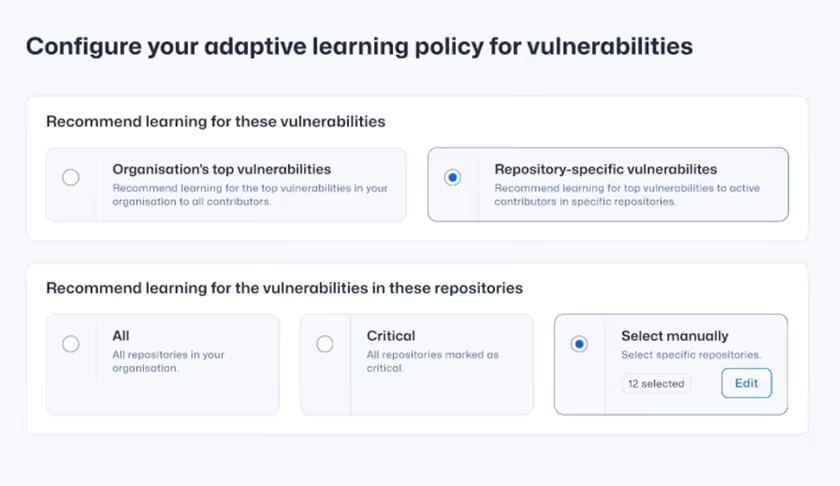
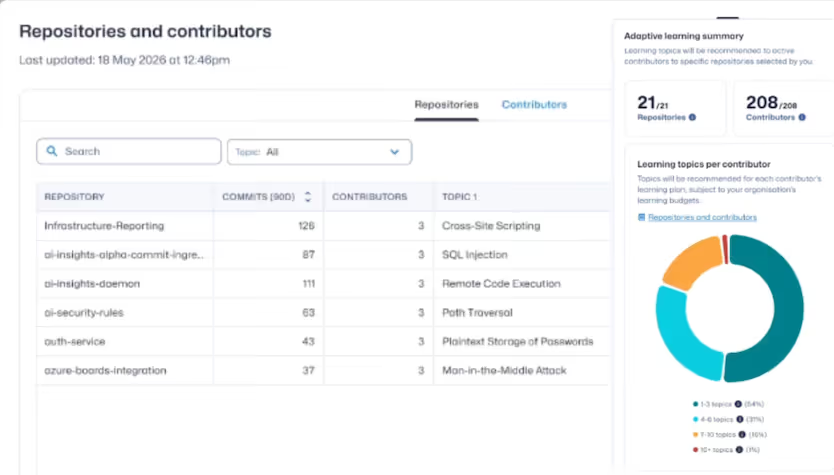
Adaptive Learning

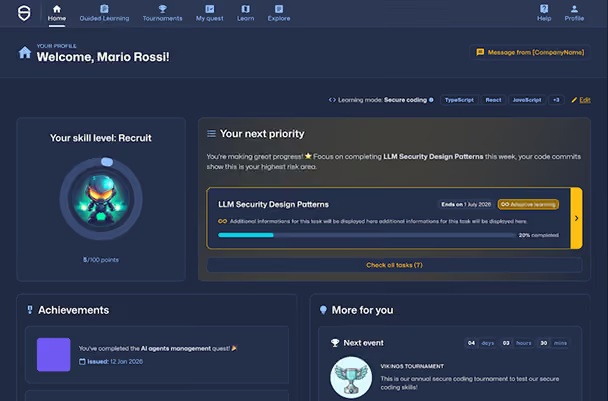
SCW automatically classifies where each developer sits on the adoption curve based on real signals from their tools, repositories, and behavior — then delivers the right content at the right time. No manual assessments. No one-size-fits-all programs. Every developer gets a clear entry point that matches where they actually are, and learning paths that evolve as they move up the curve.

get a demo
explore the platform

SCW Trust Agent

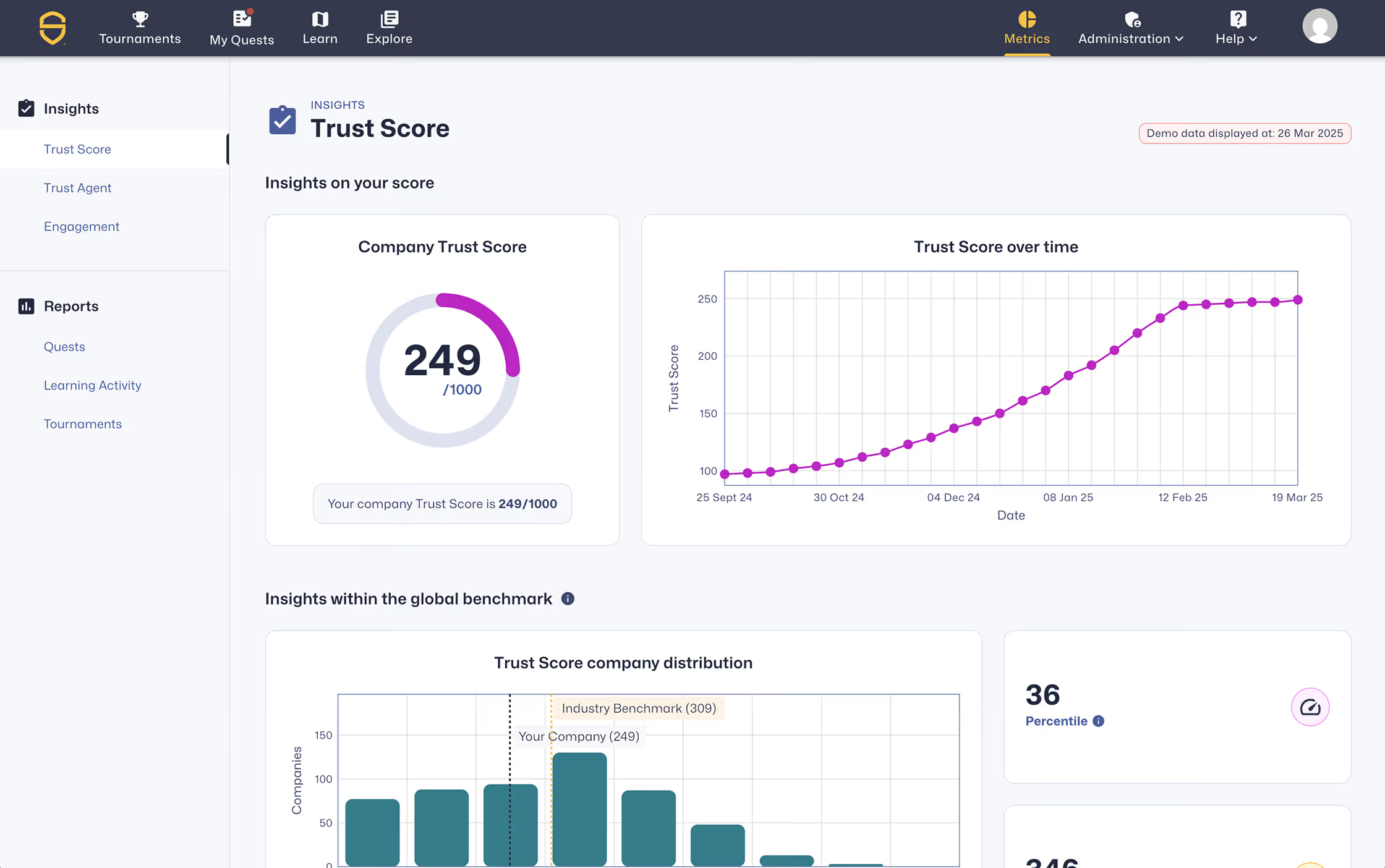
SCW Trust Agent provides commit-level visibility into AI's contribution to production code. It detects over-trust patterns, triggers adaptive learning automatically when risk signals spike, and gives CISOs the governance reporting they need to demonstrate progress — to boards, auditors, and regulators.

get a demo
explore the platform
Go deeper

The AI adoption model whitepaper

A detailed breakdown of all eight stages, proprietary benchmarking research across 660 AI-generated codebases, risk inflection point analysis, and governance recommendations for every phase of adoption.

doWNLOAD THE WHITEPAPER
AI security training for developers FAQs

Secure AI-assisted development starts with developer capability

Learn how Secure Code Warrior helps teams adopt AI safely, reduce risk, and build measurable developer capability.

What is the SCW AI adoption model?

The SCW AI adoption model maps the full progression of AI use in software development across eight stages and three phases — AI-Assisted, AI-Native, and Agentic. It gives organizations a practical framework to identify where they sit on the adoption curve, what training developers need at each stage, and which governance controls are required as AI autonomy increases.

What are the three phases of AI adoption in software development?

The three phases are AI-Assisted, where AI supports development but humans remain primary authors; AI-Native, where AI takes over most code generation and human oversight begins to degrade; and Agentic, where autonomous agents direct other agents across the full development lifecycle and governance must be entirely policy-driven.

What is a risk inflection point in AI development?

A risk inflection point is a stage in the AI adoption curve where the nature of risk changes fundamentally — not just increases. The first occurs at Stage 3, when AI moves from supervised to unsupervised activity and invisible security debt begins accumulating. The second occurs at Stage 6, when multiple agents work in parallel and individual code review becomes physically impossible.

What is the Agentic Development Lifecycle?

The Agentic Development Lifecycle — the ADLC — is the governance framework built for a dynamic development environment where autonomous agents act independently, evolve over time, and generate code faster than traditional governance controls can track. It replaces the SDLC, which was designed for human-authored code built to a schedule.

Where do most organizations sit on the AI adoption curve today?

Most organizations are operating across Stages 2 through 4, often without having mapped it. At these stages, the productivity gains from AI are clear but governance gaps are becoming critical. The largest contingent of developers is expected to be working at Stages 3 through 5 by the end of 2026.

How do CISOs govern AI use by developers?

Effective AI governance for CISOs requires three things: visibility into how AI contributes to production code, training that builds developer capability at every stage of the adoption curve, and governance controls that evolve as AI autonomy increases. The SCW AI adoption model provides a structured framework for all three.

Why are secure coding skills more important in the age of AI?

Gartner's 2026 Hype Cycle for Secure Software Engineering notes that AI coding tools are making secure coding skills more important than ever. AI writes code for the problem it is given — if no one tells it to include authentication, it won't. Without skilled developers reviewing and directing AI output, vulnerabilities ship without anyone knowing they were introduced.

Can I create AI Adoption Model training programs in Secure Code Warrior?

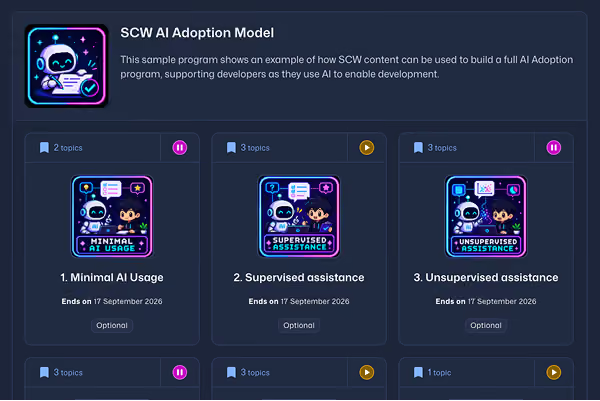
Yes. Organizations can create AI Adoption Model training programs in Quests using recommended curriculum mapped to all eight stages of the model. Secure Code Warrior provides implementation guidance, stage-specific learning recommendations, learner targeting options, and downloadable assets to help teams operationalize the model. View the Knowledge Base.

¿Aún tienes preguntas?

Detalles de soporte para captar clientes que podrían estar indecisos.

Contactar

Govern AI-driven development before it ships

See developer risk, enforce policy, and prevent vulnerabilities across your software development lifecycle.

Book a demo
trust score