Nouvelles vulnérabilités dans les bibliothèques Spring : comment savoir si vous êtes exposé et que faire

Récemment, les bibliothèques Spring, parmi les plus populaires de la communauté Java, ont révélé deux vulnérabilités liées à l'exécution de code à distance (RCE). Pour vous aider à déterminer plus facilement si vous êtes exposé à l'une de ces vulnérabilités et quelles mesures prendre, nous avons décrypté les détails connus concernant « Spring4Shell » et « Spring Cloud Function ».
Vulnérabilité 1 - « Spring4Shell » (CVE-2022-22965)
Le 29 mars 2022, la communauté a découvert une série de tweets contenant des captures d'écran d'une preuve de concept d'une exploitation ciblant Spring Core (SC), permettant l'exécution de code à distance sur toutes les versions de Spring Core, y compris la version la plus récente, la 5.3.17.
Quelles applications sont exposées ?
Actuellement, seules les applications hébergées sur Tomcat sont confirmées comme étant exposées à cette nouvelle exploitation. Bien que l'exploitation n'ait pas été démontrée comme réussie contre le conteneur de servlets Tomcat embarqué ou toute autre application non hébergée sur Tomcat, cela n'exclut pas la possibilité que la menace s'avère efficace à l'avenir contre ces frameworks.
Spring a publié une déclaration officielle concernant cette vulnérabilité, précisant que les conditions suivantes doivent être réunies pour être vulnérable, selon la compréhension actuelle de la faille :
- JDK 9 ou supérieur
- Apache Tomcat comme conteneur de servlets
- Packaging sous forme de WAR traditionnel (par opposition à un fichier jar exécutable Spring Boot)
- Dépendance spring-webmvc ou spring-webflux
- Versions du framework Spring 5.3.0 à 5.3.17, 5.2.0 à 5.2.19, et versions antérieures
Comment fonctionne l'exploitation « Spring4Shell » ?
L'exploitation repose sur l'utilisation du « Data Binding » (org.springframework.web.bind.WebDataBinder) dans les requêtes qui utilisent des objets Java simples (POJO) dans la signature de la méthode :
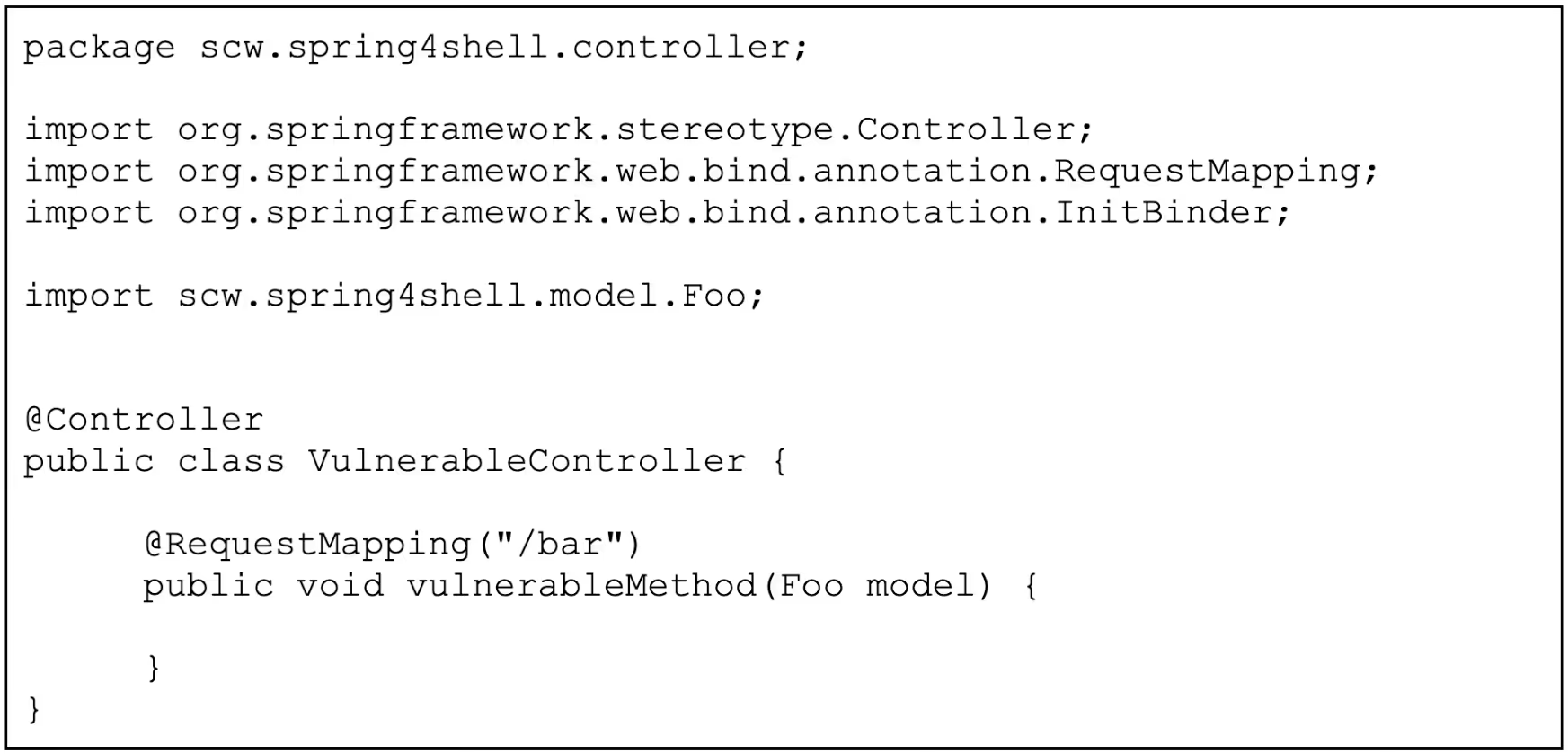
Où la classe Foo est une classe POJO, qui pourrait être définie comme suit. Notez que la classe réelle n'a pas d'importance, tant qu'elle est chargée par le chargeur de classes (Class Loader).

Lorsqu'une requête est traitée par une méthode de ce type, le chargeur de classes est utilisé pour résoudre la classe. Le chargeur de classes est responsable du chargement des classes au moment de l'exécution, sans avoir à précharger tous les types possibles en mémoire. Il détermine quel fichier .jar charger lorsqu'une nouvelle classe est utilisée.
Vous pouvez trouver les informations les plus récentes et détaillées sur cette vulnérabilité directement sur le blog de Spring, incluant les correctifs potentiels ou les solutions de contournement.
Vulnérabilité 2 - Spring Cloud Function (CVE-2022-22963)
Le 27 mars 2022, Cyber Kendra a révélé les détails d'une vulnérabilité « zero-day » d'exécution de code à distance (RCE) dans Spring Cloud Functions pour laquelle aucun correctif n'existait. La vulnérabilité a reçu l'identifiant CVE-2022-22963 : Vulnérabilité d'accès aux ressources par expression Spring.
Quelles applications sont exposées ?
La vulnérabilité affectait les applications remplissant les conditions suivantes :
- JDK 9 ou version ultérieure
- Spring Cloud Functions version 3.1.6 (ou inférieure), 3.2.2 (ou inférieure), ou toute version non prise en charge
Comment fonctionne l'exploitation ?
Spring Cloud Function permet aux développeurs de configurer le routage via la propriété spring.cloud.function.routing-expression, généralement définie par la configuration ou le code. Cette fonctionnalité puissante accepte le langage « Spring Expression Language » (SpEL). Cette vulnérabilité zero-day a révélé que cette propriété pouvait être définie via les en-têtes HTTP d'une requête. Un attaquant pouvait donc intégrer du code SpEL directement dans sa requête HTTP vers un point de terminaison RoutingFunction et ainsi exécuter du code arbitraire.
Quelles mesures les utilisateurs doivent-ils prendre pour limiter les risques ?
Spring a publié les versions 3.1.7 et 3.2.3 pour corriger ce problème en empêchant la définition de cette propriété via les en-têtes HTTP, ce qui neutralise la vulnérabilité. Aucune étape supplémentaire n'est nécessaire après la mise à jour vers l'une de ces versions.
Vous souhaitez en savoir plus sur la façon dont nous aidons les développeurs à écrire un code plus sécurisé ? Réservez une démo ou explorez nos guides de codage sécurisé gratuits sur secure code coach.
Sources
- https://www.lunasec.io/docs/blog/spring-rce-vulnerabilities/
- https://www.rapid7.com/blog/post/2022/03/30/spring4shell-zero-day-vulnerability-in-spring-framework/
Gouvernez le développement assisté par IA avant la mise en production
Évaluez les risques liés à l'IA, appliquez des politiques de codage sécurisé dès le commit et accélérez la livraison sécurisée tout au long de votre cycle de développement.
Explorer plus d'articles
Accédez à du contenu expert sur le codage sécurisé, la gouvernance de l'IA et la gestion des risques logiciels.
%252520%252520(3).avif)
Supercharged Security Awareness: How Tournaments are Inspiring Developers at Erste Group
Lorem ipsum dolor sit amet, consectetur adipiscing elit. Suspendisse varius enim in eros elementum tristique. Duis cursus, mi quis viverra ornare, eros dolor interdum nulla, ut commodo diam libero vitae erat. Aenean faucibus nibh et justo cursus id rutrum lorem imperdiet. Nunc ut sem vitae risus tristique posuere.

Security as culture: How Blue Prism cultivates world-class secure developers
Learn how Blue Prism, the global leader in intelligent automation for the enterprise, used Secure Code Warrior's agile learning platform to create a security-first culture with their developers, achieve their business goals, and ship secure code at speed

Une culture de la sécurité : comment Sage a bâti son programme de champions
Découvrez comment Sage a renforcé sa sécurité grâce à une approche flexible axée sur les relations humaines, formant plus de 200 champions de la sécurité et obtenant une réduction mesurable des risques.
Mois de la sensibilisation à la cybersécurité 2026 : comprendre la sécurité de l'IA est essentiel à la défense de l'entreprise
Nous avons atteint un point où la plupart des grandes entreprises d'IA ont publiquement appelé à un ralentissement mondial du développement de l'IA afin de permettre aux garde-fous de sécurité de rattraper leur retard. Pourtant, la réalité est que de graves problèmes de sécurité se sont déjà concrétisés. Cela place d'innombrables responsables de la sécurité et équipes de direction dans une situation d'urgence, alors que les coûts financiers et les risques liés à la mise en œuvre de l'IA ne cessent de s'accumuler.
Levier 8 : Valoriser votre programme
Un programme de codage sécurisé a besoin de plus qu'un contenu de qualité pour réussir. Le levier 8 montre comment l'image de marque transforme la participation en une expérience convoitée, axée sur le statut.
.avif)
Chaque employé est désormais en première ligne de la cybersécurité IA
Le paysage technologique des entreprises évolue à une vitesse que peu avaient anticipée avant qu'il ne soit trop tard. Nous avons officiellement franchi le cap du code écrit par l'humain et de l'assistance basique par copilote pour entrer dans l'ère du cycle de vie de développement agentique (ADLC). Si les agents IA autonomes promettent une efficacité sans précédent dans de multiples fonctions, ils apportent également une toute nouvelle catégorie de risques en matière de sécurité et de réglementation.
Sécurisez le développement piloté par l'IA avant le déploiement
Identifiez les risques de développement, appliquez vos politiques et prévenez les vulnérabilités tout au long du cycle de vie de vos logiciels.