

Les efforts de l'ASRG en faveur de la sécurité des logiciels automobiles

Tournament Torque: ASRG’s push for automotive software security
The Automotive Security Research Group is a non-profit organization dedicated to raising awareness and supporting the development of security for the automotive industry, with a focus on finding and promoting solutions that make automotive products safer and more secure. At the moment, this industry is changing and going through the next revolution to connected, autonomous, shared, electrified and software-defined vehicles. As we head into this brave new technological world for the industry, with an enormous increasing dependence on software powering vehicles and ecosystem applications, organizations like ASRG play a key role in drawing attention to and upholding software security within the automotive industry.
This awareness, and most importantly, manufacturers acting upon it, will be crucial as potential attack vectors and cyber risk expands with increased adoption of new vehicle technology in the consumer market. The FBI recently warned of attackers targeting the US auto industry, with a large majority of breaches the result of unencrypted sensitive data. This, in addition to attacks like brute-forcing poorly configured databases, could spell huge and potentially lethal consequences. As part of their research into solutions and tools that help shape and uphold software security standards in automotive products, the team at ASRG took Secure Code Warrior’s platform for a test drive, namely the Tournaments function. Purpose-built to engage developers through friendly, gamified competition, increase their security awareness and help hone their secure coding skills, ASRG looked into how Secure Code Warrior could spark developer interest in security, teach them the skills to stop common vulnerabilities that affect automotive software and open the floodgates to unacceptable risk.
Where are the typical attack vectors in automotive software?
When analyzing the potential avenues for attackers to access automotive software, there are many possibilities, as detailed by Allot’s comprehensive report.
No matter how security-aware, developers cannot help to defend against them all (nor should they be expected to – AppSec specialists exist for a reason!) but there are plenty of common back doors that savvy engineers can close in their code before they become a serious problem, like:
There are plenty of common backdoors that savvy engineers can close in their code before they become a serious problem
How serious is the situation of a compromised vehicle?
It is fairly obvious to the average person that most vehicles arenot 100% safe, and that an element of risk is taken when usingthem. Motor vehicle malfunctions, accidents, drink-driving … all of these carry a potentially fatal outcome for a road user.
But what if that catastrophic vehicle malfunction was actually caused remotely, as a result of a particularly malicious cyberattack? It has long been suggested that the world will get serious about cybersecurity when there are life-threatening consequences, but the reality is that we are well into that territory already, and without intervention, it will only escalate from here.
Back in 2015, security researchers successfully “killed” the engine of a Jeep Cherokee as it drove on a freeway; using a known zero-day exploit in the system software, they could wirelessly control the air conditioning, radio, steering, brakes, and transmission. Though dangerous, this was a contained experiment, but it proved the lethal control an attacker could have over a vehicle and its occupants. Since this event, millions of connected vehicles have hit our roads, each representing millions of lines of code that must be secured.
Autonomous vehicle technology (and its adoption) is moving at a cracking pace, and this can have the consequence of immense strain on its creators, especially the teams responsible for shipping the code that powers the conveniences of tomorrow. There is an urgent need for software developers in the automotive industry to share the responsibility for security, and ASRG is the community hub many rely on for the latest security knowledge, tools, peer recommendations, and support. Their global Secure Code Warrior tournament sought to engage, assess, and inspire over 100 developers representing ASRG chapters all over the world. Participating in friendly competition and training, they sought to solve secure coding challenges that directly relate to the issues facing the software prevalent in their industry.
Autonomous vehicle technology(and its adoption)is moving at a cracking pace, and this can have the consequence of immense strain on its creators, especially the teams responsible for shipping the code that powers the conveniences of tomorrow.

The facts and figures from tournament and training trials
This is an indication of high engagement and a desire to keep playing – both immensely beneficial byproducts of gamification techniques in training and education.
Training and tournaments can be played in the languages and frameworks as desired by each individual developer, ensuring that challenges are hyper-relevant and using real-world code they would come across in day-to-day work. This contextual, bite-sized approach to learning ensures swift delivery of the content that matters most to solve the problems most prevalent in the organization’s SDLC.
The most common developer profile among participants

Other Significant Findings:
Global ASRG Virtual Secure Coding Tournament: Secure Code Score per Language

Global ASRG Virtual Secure Coding Tournament: Secure Code Score per Vulnerability


While all participants showed some proficiency in their chosen languages and frameworks, there was no single vulnerability area that was deemed “100% secure”, or mastered, and the average accuracy score was 67%.There is no expectation for any developer to become a security expert, but tournaments are a great way to introduce security standards, a benchmark of quality, and the responsibility to learn how to squash common security bugs in code… especially when that code may lead to remote access control of someone’s vehicle, or worse.
Tournament insights into vulnerability and skill-based risk factors
The ASRG tournament and training initiatives concentrated on some key vulnerabilities that affect connected vehicles, namely:

After thousands of training minutes and hundreds of challenges, it became apparent that the clear areas of focus should remain on access control, sensitive data storage, and, as a priority, memory corruption vulnerabilities. The latter is a known potential exploit in not just ultra-connected vehicles, but many other IoT devices.
Such a bug was recently discovered by Cisco's Customer Experience Assessment & Penetration Team (CX APT) in GNU Glibc, a library used in Linux ARMv7 systems, leaving them vulnerable to memory corruption until a patch is created and applied. In these times of sensor-heavy devices using real-time data collection from multiple environmental points, the pay dirt could be significant for an attacker, even if remote control of the device isn’t possible.
The team at ASRG have built incredible resources for developers needing to perform in automotive security, with their directory of tested tools and solutions, comprehensive wiki, and powerful global community. These independent group initiatives are what takes to drive change at a grassroots level, and their willingness to try new things and forge the foundations of security awareness in their members is a powerful element in stopping recurring vulnerabilities in highly sensitive devices.
Return on investment from spending now on secure coding best practices
A study published by SAE International and the Synopsys Software IntegrityGroup found that, in terms of ensuring connected technologies were secured and safeguarded from both existing and emerging cyber threats, the automotive industry was significantly lagging behind many others.
It’s a concerning trend, but it’s not irreversible - especially with organizations like ASRG fighting to keep security front-of-mind in the industry, while shedding light on the solutions, tools, and education needed for automotive companies to build an iron-clad security program.
Their experience with running a highly engaging, global Secure Code Warrior Tournament gave them the opportunity to identify core areas of risk within a development cohort, opportunities for further learning, accuracy statistics from secure coding challenges, and the key vulnerabilities to focus on, as relevant to the needs of the industry.
So, what would the estimated returns on transforming a security program within an organization, instilling security awareness and action from the very beginning of the SDLC? Let’s take a look:
For a business identifying even a modest number of annual vulnerabilities in their security audits, the potential costs of detection and remediation can be significant. And, depending on where these annoying bugs are revealed in the process, the price of correction can dramatically increase, even for the “simple” fixes - up to thirty times the cost for a late-stage fix, versus one that was found and fixed at the beginning.

Return on investment
This three-point estimateshows the potentialfinancial and day impactof three different savingsenabled by SecureCode Warrior’s training,tournaments, and culturaltransformation.

Potential annual savings


Explorez cette étude de cas complète pour en savoir plus sur la façon dont l'entreprise a utilisé les tournois de Secure Code Warrior pour impliquer les développeurs, mieux faire connaître les principales vulnérabilités affectant les logiciels automobiles et obtenir des statistiques dans de nombreux langages et frameworks.
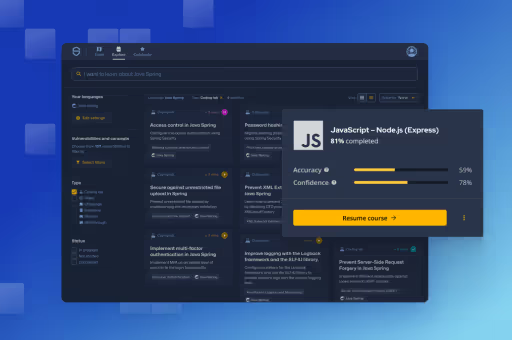
Secure Code Warrior est là pour aider votre organisation à sécuriser le code tout au long du cycle de développement logiciel et à créer une culture dans laquelle la cybersécurité est une priorité. Que vous soyez responsable de la sécurité des applications, développeur, responsable de la sécurité informatique ou toute autre personne impliquée dans la sécurité, nous pouvons aider votre organisation à réduire les risques associés à un code non sécurisé.
Réservez une démo


Tournament Torque: ASRG’s push for automotive software security
The Automotive Security Research Group is a non-profit organization dedicated to raising awareness and supporting the development of security for the automotive industry, with a focus on finding and promoting solutions that make automotive products safer and more secure. At the moment, this industry is changing and going through the next revolution to connected, autonomous, shared, electrified and software-defined vehicles. As we head into this brave new technological world for the industry, with an enormous increasing dependence on software powering vehicles and ecosystem applications, organizations like ASRG play a key role in drawing attention to and upholding software security within the automotive industry.
This awareness, and most importantly, manufacturers acting upon it, will be crucial as potential attack vectors and cyber risk expands with increased adoption of new vehicle technology in the consumer market. The FBI recently warned of attackers targeting the US auto industry, with a large majority of breaches the result of unencrypted sensitive data. This, in addition to attacks like brute-forcing poorly configured databases, could spell huge and potentially lethal consequences. As part of their research into solutions and tools that help shape and uphold software security standards in automotive products, the team at ASRG took Secure Code Warrior’s platform for a test drive, namely the Tournaments function. Purpose-built to engage developers through friendly, gamified competition, increase their security awareness and help hone their secure coding skills, ASRG looked into how Secure Code Warrior could spark developer interest in security, teach them the skills to stop common vulnerabilities that affect automotive software and open the floodgates to unacceptable risk.
Where are the typical attack vectors in automotive software?
When analyzing the potential avenues for attackers to access automotive software, there are many possibilities, as detailed by Allot’s comprehensive report.
No matter how security-aware, developers cannot help to defend against them all (nor should they be expected to – AppSec specialists exist for a reason!) but there are plenty of common back doors that savvy engineers can close in their code before they become a serious problem, like:
There are plenty of common backdoors that savvy engineers can close in their code before they become a serious problem
How serious is the situation of a compromised vehicle?
It is fairly obvious to the average person that most vehicles arenot 100% safe, and that an element of risk is taken when usingthem. Motor vehicle malfunctions, accidents, drink-driving … all of these carry a potentially fatal outcome for a road user.
But what if that catastrophic vehicle malfunction was actually caused remotely, as a result of a particularly malicious cyberattack? It has long been suggested that the world will get serious about cybersecurity when there are life-threatening consequences, but the reality is that we are well into that territory already, and without intervention, it will only escalate from here.
Back in 2015, security researchers successfully “killed” the engine of a Jeep Cherokee as it drove on a freeway; using a known zero-day exploit in the system software, they could wirelessly control the air conditioning, radio, steering, brakes, and transmission. Though dangerous, this was a contained experiment, but it proved the lethal control an attacker could have over a vehicle and its occupants. Since this event, millions of connected vehicles have hit our roads, each representing millions of lines of code that must be secured.
Autonomous vehicle technology (and its adoption) is moving at a cracking pace, and this can have the consequence of immense strain on its creators, especially the teams responsible for shipping the code that powers the conveniences of tomorrow. There is an urgent need for software developers in the automotive industry to share the responsibility for security, and ASRG is the community hub many rely on for the latest security knowledge, tools, peer recommendations, and support. Their global Secure Code Warrior tournament sought to engage, assess, and inspire over 100 developers representing ASRG chapters all over the world. Participating in friendly competition and training, they sought to solve secure coding challenges that directly relate to the issues facing the software prevalent in their industry.
Autonomous vehicle technology(and its adoption)is moving at a cracking pace, and this can have the consequence of immense strain on its creators, especially the teams responsible for shipping the code that powers the conveniences of tomorrow.
The facts and figures from tournament and training trials
This is an indication of high engagement and a desire to keep playing – both immensely beneficial byproducts of gamification techniques in training and education.
Training and tournaments can be played in the languages and frameworks as desired by each individual developer, ensuring that challenges are hyper-relevant and using real-world code they would come across in day-to-day work. This contextual, bite-sized approach to learning ensures swift delivery of the content that matters most to solve the problems most prevalent in the organization’s SDLC.
The most common developer profile among participants
Other Significant Findings:
Global ASRG Virtual Secure Coding Tournament: Secure Code Score per Language
Global ASRG Virtual Secure Coding Tournament: Secure Code Score per Vulnerability
While all participants showed some proficiency in their chosen languages and frameworks, there was no single vulnerability area that was deemed “100% secure”, or mastered, and the average accuracy score was 67%.There is no expectation for any developer to become a security expert, but tournaments are a great way to introduce security standards, a benchmark of quality, and the responsibility to learn how to squash common security bugs in code… especially when that code may lead to remote access control of someone’s vehicle, or worse.
Tournament insights into vulnerability and skill-based risk factors
The ASRG tournament and training initiatives concentrated on some key vulnerabilities that affect connected vehicles, namely:
After thousands of training minutes and hundreds of challenges, it became apparent that the clear areas of focus should remain on access control, sensitive data storage, and, as a priority, memory corruption vulnerabilities. The latter is a known potential exploit in not just ultra-connected vehicles, but many other IoT devices.
Such a bug was recently discovered by Cisco's Customer Experience Assessment & Penetration Team (CX APT) in GNU Glibc, a library used in Linux ARMv7 systems, leaving them vulnerable to memory corruption until a patch is created and applied. In these times of sensor-heavy devices using real-time data collection from multiple environmental points, the pay dirt could be significant for an attacker, even if remote control of the device isn’t possible.
The team at ASRG have built incredible resources for developers needing to perform in automotive security, with their directory of tested tools and solutions, comprehensive wiki, and powerful global community. These independent group initiatives are what takes to drive change at a grassroots level, and their willingness to try new things and forge the foundations of security awareness in their members is a powerful element in stopping recurring vulnerabilities in highly sensitive devices.
Return on investment from spending now on secure coding best practices
A study published by SAE International and the Synopsys Software IntegrityGroup found that, in terms of ensuring connected technologies were secured and safeguarded from both existing and emerging cyber threats, the automotive industry was significantly lagging behind many others.
It’s a concerning trend, but it’s not irreversible - especially with organizations like ASRG fighting to keep security front-of-mind in the industry, while shedding light on the solutions, tools, and education needed for automotive companies to build an iron-clad security program.
Their experience with running a highly engaging, global Secure Code Warrior Tournament gave them the opportunity to identify core areas of risk within a development cohort, opportunities for further learning, accuracy statistics from secure coding challenges, and the key vulnerabilities to focus on, as relevant to the needs of the industry.
So, what would the estimated returns on transforming a security program within an organization, instilling security awareness and action from the very beginning of the SDLC? Let’s take a look:
For a business identifying even a modest number of annual vulnerabilities in their security audits, the potential costs of detection and remediation can be significant. And, depending on where these annoying bugs are revealed in the process, the price of correction can dramatically increase, even for the “simple” fixes - up to thirty times the cost for a late-stage fix, versus one that was found and fixed at the beginning.
Return on investment
This three-point estimateshows the potentialfinancial and day impactof three different savingsenabled by SecureCode Warrior’s training,tournaments, and culturaltransformation.
Potential annual savings


Tournament Torque: ASRG’s push for automotive software security
The Automotive Security Research Group is a non-profit organization dedicated to raising awareness and supporting the development of security for the automotive industry, with a focus on finding and promoting solutions that make automotive products safer and more secure. At the moment, this industry is changing and going through the next revolution to connected, autonomous, shared, electrified and software-defined vehicles. As we head into this brave new technological world for the industry, with an enormous increasing dependence on software powering vehicles and ecosystem applications, organizations like ASRG play a key role in drawing attention to and upholding software security within the automotive industry.
This awareness, and most importantly, manufacturers acting upon it, will be crucial as potential attack vectors and cyber risk expands with increased adoption of new vehicle technology in the consumer market. The FBI recently warned of attackers targeting the US auto industry, with a large majority of breaches the result of unencrypted sensitive data. This, in addition to attacks like brute-forcing poorly configured databases, could spell huge and potentially lethal consequences. As part of their research into solutions and tools that help shape and uphold software security standards in automotive products, the team at ASRG took Secure Code Warrior’s platform for a test drive, namely the Tournaments function. Purpose-built to engage developers through friendly, gamified competition, increase their security awareness and help hone their secure coding skills, ASRG looked into how Secure Code Warrior could spark developer interest in security, teach them the skills to stop common vulnerabilities that affect automotive software and open the floodgates to unacceptable risk.
Where are the typical attack vectors in automotive software?
When analyzing the potential avenues for attackers to access automotive software, there are many possibilities, as detailed by Allot’s comprehensive report.
No matter how security-aware, developers cannot help to defend against them all (nor should they be expected to – AppSec specialists exist for a reason!) but there are plenty of common back doors that savvy engineers can close in their code before they become a serious problem, like:
There are plenty of common backdoors that savvy engineers can close in their code before they become a serious problem
How serious is the situation of a compromised vehicle?
It is fairly obvious to the average person that most vehicles arenot 100% safe, and that an element of risk is taken when usingthem. Motor vehicle malfunctions, accidents, drink-driving … all of these carry a potentially fatal outcome for a road user.
But what if that catastrophic vehicle malfunction was actually caused remotely, as a result of a particularly malicious cyberattack? It has long been suggested that the world will get serious about cybersecurity when there are life-threatening consequences, but the reality is that we are well into that territory already, and without intervention, it will only escalate from here.
Back in 2015, security researchers successfully “killed” the engine of a Jeep Cherokee as it drove on a freeway; using a known zero-day exploit in the system software, they could wirelessly control the air conditioning, radio, steering, brakes, and transmission. Though dangerous, this was a contained experiment, but it proved the lethal control an attacker could have over a vehicle and its occupants. Since this event, millions of connected vehicles have hit our roads, each representing millions of lines of code that must be secured.
Autonomous vehicle technology (and its adoption) is moving at a cracking pace, and this can have the consequence of immense strain on its creators, especially the teams responsible for shipping the code that powers the conveniences of tomorrow. There is an urgent need for software developers in the automotive industry to share the responsibility for security, and ASRG is the community hub many rely on for the latest security knowledge, tools, peer recommendations, and support. Their global Secure Code Warrior tournament sought to engage, assess, and inspire over 100 developers representing ASRG chapters all over the world. Participating in friendly competition and training, they sought to solve secure coding challenges that directly relate to the issues facing the software prevalent in their industry.
Autonomous vehicle technology(and its adoption)is moving at a cracking pace, and this can have the consequence of immense strain on its creators, especially the teams responsible for shipping the code that powers the conveniences of tomorrow.
The facts and figures from tournament and training trials
This is an indication of high engagement and a desire to keep playing – both immensely beneficial byproducts of gamification techniques in training and education.
Training and tournaments can be played in the languages and frameworks as desired by each individual developer, ensuring that challenges are hyper-relevant and using real-world code they would come across in day-to-day work. This contextual, bite-sized approach to learning ensures swift delivery of the content that matters most to solve the problems most prevalent in the organization’s SDLC.
The most common developer profile among participants
Other Significant Findings:
Global ASRG Virtual Secure Coding Tournament: Secure Code Score per Language
Global ASRG Virtual Secure Coding Tournament: Secure Code Score per Vulnerability
While all participants showed some proficiency in their chosen languages and frameworks, there was no single vulnerability area that was deemed “100% secure”, or mastered, and the average accuracy score was 67%.There is no expectation for any developer to become a security expert, but tournaments are a great way to introduce security standards, a benchmark of quality, and the responsibility to learn how to squash common security bugs in code… especially when that code may lead to remote access control of someone’s vehicle, or worse.
Tournament insights into vulnerability and skill-based risk factors
The ASRG tournament and training initiatives concentrated on some key vulnerabilities that affect connected vehicles, namely:
After thousands of training minutes and hundreds of challenges, it became apparent that the clear areas of focus should remain on access control, sensitive data storage, and, as a priority, memory corruption vulnerabilities. The latter is a known potential exploit in not just ultra-connected vehicles, but many other IoT devices.
Such a bug was recently discovered by Cisco's Customer Experience Assessment & Penetration Team (CX APT) in GNU Glibc, a library used in Linux ARMv7 systems, leaving them vulnerable to memory corruption until a patch is created and applied. In these times of sensor-heavy devices using real-time data collection from multiple environmental points, the pay dirt could be significant for an attacker, even if remote control of the device isn’t possible.
The team at ASRG have built incredible resources for developers needing to perform in automotive security, with their directory of tested tools and solutions, comprehensive wiki, and powerful global community. These independent group initiatives are what takes to drive change at a grassroots level, and their willingness to try new things and forge the foundations of security awareness in their members is a powerful element in stopping recurring vulnerabilities in highly sensitive devices.
Return on investment from spending now on secure coding best practices
A study published by SAE International and the Synopsys Software IntegrityGroup found that, in terms of ensuring connected technologies were secured and safeguarded from both existing and emerging cyber threats, the automotive industry was significantly lagging behind many others.
It’s a concerning trend, but it’s not irreversible - especially with organizations like ASRG fighting to keep security front-of-mind in the industry, while shedding light on the solutions, tools, and education needed for automotive companies to build an iron-clad security program.
Their experience with running a highly engaging, global Secure Code Warrior Tournament gave them the opportunity to identify core areas of risk within a development cohort, opportunities for further learning, accuracy statistics from secure coding challenges, and the key vulnerabilities to focus on, as relevant to the needs of the industry.
So, what would the estimated returns on transforming a security program within an organization, instilling security awareness and action from the very beginning of the SDLC? Let’s take a look:
For a business identifying even a modest number of annual vulnerabilities in their security audits, the potential costs of detection and remediation can be significant. And, depending on where these annoying bugs are revealed in the process, the price of correction can dramatically increase, even for the “simple” fixes - up to thirty times the cost for a late-stage fix, versus one that was found and fixed at the beginning.
Return on investment
This three-point estimateshows the potentialfinancial and day impactof three different savingsenabled by SecureCode Warrior’s training,tournaments, and culturaltransformation.
Potential annual savings
Cliquez sur le lien ci-dessous et téléchargez le PDF de cette ressource.
Secure Code Warrior est là pour aider votre organisation à sécuriser le code tout au long du cycle de développement logiciel et à créer une culture dans laquelle la cybersécurité est une priorité. Que vous soyez responsable de la sécurité des applications, développeur, responsable de la sécurité informatique ou toute autre personne impliquée dans la sécurité, nous pouvons aider votre organisation à réduire les risques associés à un code non sécurisé.
Afficher le rapportRéservez une démo
Vous souhaitez essayer Secure Code Warrior mais vous n'avez pas encore de compte ? Ouvrez un compte d'essai gratuit dès aujourd'hui pour commencer.
Essayer dès maintenantTournament Torque: ASRG’s push for automotive software security
The Automotive Security Research Group is a non-profit organization dedicated to raising awareness and supporting the development of security for the automotive industry, with a focus on finding and promoting solutions that make automotive products safer and more secure. At the moment, this industry is changing and going through the next revolution to connected, autonomous, shared, electrified and software-defined vehicles. As we head into this brave new technological world for the industry, with an enormous increasing dependence on software powering vehicles and ecosystem applications, organizations like ASRG play a key role in drawing attention to and upholding software security within the automotive industry.
This awareness, and most importantly, manufacturers acting upon it, will be crucial as potential attack vectors and cyber risk expands with increased adoption of new vehicle technology in the consumer market. The FBI recently warned of attackers targeting the US auto industry, with a large majority of breaches the result of unencrypted sensitive data. This, in addition to attacks like brute-forcing poorly configured databases, could spell huge and potentially lethal consequences. As part of their research into solutions and tools that help shape and uphold software security standards in automotive products, the team at ASRG took Secure Code Warrior’s platform for a test drive, namely the Tournaments function. Purpose-built to engage developers through friendly, gamified competition, increase their security awareness and help hone their secure coding skills, ASRG looked into how Secure Code Warrior could spark developer interest in security, teach them the skills to stop common vulnerabilities that affect automotive software and open the floodgates to unacceptable risk.
Where are the typical attack vectors in automotive software?
When analyzing the potential avenues for attackers to access automotive software, there are many possibilities, as detailed by Allot’s comprehensive report.
No matter how security-aware, developers cannot help to defend against them all (nor should they be expected to – AppSec specialists exist for a reason!) but there are plenty of common back doors that savvy engineers can close in their code before they become a serious problem, like:
There are plenty of common backdoors that savvy engineers can close in their code before they become a serious problem
How serious is the situation of a compromised vehicle?
It is fairly obvious to the average person that most vehicles arenot 100% safe, and that an element of risk is taken when usingthem. Motor vehicle malfunctions, accidents, drink-driving … all of these carry a potentially fatal outcome for a road user.
But what if that catastrophic vehicle malfunction was actually caused remotely, as a result of a particularly malicious cyberattack? It has long been suggested that the world will get serious about cybersecurity when there are life-threatening consequences, but the reality is that we are well into that territory already, and without intervention, it will only escalate from here.
Back in 2015, security researchers successfully “killed” the engine of a Jeep Cherokee as it drove on a freeway; using a known zero-day exploit in the system software, they could wirelessly control the air conditioning, radio, steering, brakes, and transmission. Though dangerous, this was a contained experiment, but it proved the lethal control an attacker could have over a vehicle and its occupants. Since this event, millions of connected vehicles have hit our roads, each representing millions of lines of code that must be secured.
Autonomous vehicle technology (and its adoption) is moving at a cracking pace, and this can have the consequence of immense strain on its creators, especially the teams responsible for shipping the code that powers the conveniences of tomorrow. There is an urgent need for software developers in the automotive industry to share the responsibility for security, and ASRG is the community hub many rely on for the latest security knowledge, tools, peer recommendations, and support. Their global Secure Code Warrior tournament sought to engage, assess, and inspire over 100 developers representing ASRG chapters all over the world. Participating in friendly competition and training, they sought to solve secure coding challenges that directly relate to the issues facing the software prevalent in their industry.
Autonomous vehicle technology(and its adoption)is moving at a cracking pace, and this can have the consequence of immense strain on its creators, especially the teams responsible for shipping the code that powers the conveniences of tomorrow.
The facts and figures from tournament and training trials
This is an indication of high engagement and a desire to keep playing – both immensely beneficial byproducts of gamification techniques in training and education.
Training and tournaments can be played in the languages and frameworks as desired by each individual developer, ensuring that challenges are hyper-relevant and using real-world code they would come across in day-to-day work. This contextual, bite-sized approach to learning ensures swift delivery of the content that matters most to solve the problems most prevalent in the organization’s SDLC.
The most common developer profile among participants
Other Significant Findings:
Global ASRG Virtual Secure Coding Tournament: Secure Code Score per Language
Global ASRG Virtual Secure Coding Tournament: Secure Code Score per Vulnerability
While all participants showed some proficiency in their chosen languages and frameworks, there was no single vulnerability area that was deemed “100% secure”, or mastered, and the average accuracy score was 67%.There is no expectation for any developer to become a security expert, but tournaments are a great way to introduce security standards, a benchmark of quality, and the responsibility to learn how to squash common security bugs in code… especially when that code may lead to remote access control of someone’s vehicle, or worse.
Tournament insights into vulnerability and skill-based risk factors
The ASRG tournament and training initiatives concentrated on some key vulnerabilities that affect connected vehicles, namely:
After thousands of training minutes and hundreds of challenges, it became apparent that the clear areas of focus should remain on access control, sensitive data storage, and, as a priority, memory corruption vulnerabilities. The latter is a known potential exploit in not just ultra-connected vehicles, but many other IoT devices.
Such a bug was recently discovered by Cisco's Customer Experience Assessment & Penetration Team (CX APT) in GNU Glibc, a library used in Linux ARMv7 systems, leaving them vulnerable to memory corruption until a patch is created and applied. In these times of sensor-heavy devices using real-time data collection from multiple environmental points, the pay dirt could be significant for an attacker, even if remote control of the device isn’t possible.
The team at ASRG have built incredible resources for developers needing to perform in automotive security, with their directory of tested tools and solutions, comprehensive wiki, and powerful global community. These independent group initiatives are what takes to drive change at a grassroots level, and their willingness to try new things and forge the foundations of security awareness in their members is a powerful element in stopping recurring vulnerabilities in highly sensitive devices.
Return on investment from spending now on secure coding best practices
A study published by SAE International and the Synopsys Software IntegrityGroup found that, in terms of ensuring connected technologies were secured and safeguarded from both existing and emerging cyber threats, the automotive industry was significantly lagging behind many others.
It’s a concerning trend, but it’s not irreversible - especially with organizations like ASRG fighting to keep security front-of-mind in the industry, while shedding light on the solutions, tools, and education needed for automotive companies to build an iron-clad security program.
Their experience with running a highly engaging, global Secure Code Warrior Tournament gave them the opportunity to identify core areas of risk within a development cohort, opportunities for further learning, accuracy statistics from secure coding challenges, and the key vulnerabilities to focus on, as relevant to the needs of the industry.
So, what would the estimated returns on transforming a security program within an organization, instilling security awareness and action from the very beginning of the SDLC? Let’s take a look:
For a business identifying even a modest number of annual vulnerabilities in their security audits, the potential costs of detection and remediation can be significant. And, depending on where these annoying bugs are revealed in the process, the price of correction can dramatically increase, even for the “simple” fixes - up to thirty times the cost for a late-stage fix, versus one that was found and fixed at the beginning.
Return on investment
This three-point estimateshows the potentialfinancial and day impactof three different savingsenabled by SecureCode Warrior’s training,tournaments, and culturaltransformation.
Potential annual savings
Table des matières
Secure Code Warrior est là pour aider votre organisation à sécuriser le code tout au long du cycle de développement logiciel et à créer une culture dans laquelle la cybersécurité est une priorité. Que vous soyez responsable de la sécurité des applications, développeur, responsable de la sécurité informatique ou toute autre personne impliquée dans la sécurité, nous pouvons aider votre organisation à réduire les risques associés à un code non sécurisé.
Réservez une démoTéléchargerRessources pour vous aider à démarrer



Ressources pour vous aider à démarrer
Secure Code Warrior named twice in the Gartner Hype Cycle for secure software engineering
Gartner names SCW twice. As AI agents take over more development, SCW gives you the capability and governance to adopt AI-driven development securely.


Secure coding learning that reflects real AI usage
Align secure coding training to real AI development activity — automatically assigning guidance to developers using AI tools, without manual intervention.Align secure coding training to real AI development activity — automatically assigning guidance to developers using AI tools, without manual intervention.

Train developers on the real risks in their code, whether human-written or AI-generated
Adaptive Learning auto-assigns targeted secure coding training to the developers introducing real vulnerabilities, reducing recurring risks at the source.Secure Code Warrior blog banner with a blue overlay over a developer working at a multi-monitor desk displaying code, alongside the headline 'Train developers on the real risks in their code.'l