

코더 컨커 시큐리티 OWASP 상위 10 API 시리즈 - 대량 할당


The mass assignment vulnerability was born because many modern frameworks encourage developers to use functions that automatically bind input from clients into code variables and internal objects. This is done to simplify code and speed up operations.
Attackers can use this methodology to force changes to object properties that should never be updated by a client. Normally this results in business-specific problems, like a user adding admin privileges to themselves as opposed to bringing down a website or stealing corporate secrets. Attackers must also have some idea of the relationships between objects and the business logic of the application they are exploiting.
However, none of that makes the mass assignment vulnerability any less dangerous in the hands of a clever and malicious user.
Before we launch into the full guide, play our gamified challenge and see how you fare:
How can attackers exploit the mass assignment vulnerability?
The scenario put forward by OWASP (and modified slightly by us) assumes a ride-sharing application that includes different properties bound to objects in the code using mass assignment. These include permission-related properties that users can change and process-dependent properties that should only be set internally by the application. Both use mass assignment to bind properties to objects.
In this scenario, the ride-sharing application allows users to update their profiles, as is common in many user-facing applications. This is done using an API call sent to PUT, which returns the following JSON object:
{"user_name":"SneakySnake", "age":17, "is_admin":false}
Because the attacker, Mr. SneakySnake in this case, has figured out the relationship between the properties and the objects, he can resend his original request to update his profile with the following string:
{"user_name":"SneakySnake","age":24,, "is_admin":true}
As the endpoint is vulnerable to mass assignment, it accepts the new input as valid. Not only did our hacker add a few years to his profile, but he also assigned himself admin privileges.
Eliminating the mass assignment vulnerability
As convenient as it might be to use the mass assignment function in some frameworks, you should avoid doing that if you want to keep your APIs secure. Instead, parse request values rather than binding them directly to an object. You can also use a reduced data transfer object which would provide nearly the same convenience as binding directly to the object itself, only without the associated risk.
As an extra precaution, sensitive properties like admin privileges from the example above could be denied so that they will never be accepted by the server on an API call. An even better idea might be to deny every property by default and then allow specific, non-sensitive ones that you want users to be able to update or change. Doing any of those things can help to lock down APIs and eliminate the mass assignment vulnerability from your environment.
Check out the Secure Code Warrior blog pages for more insight about this vulnerability and how to protect your organization and customers from the ravages of other security flaws. You can also try a demo of the Secure Code Warrior training platform to keep all your cybersecurity skills honed and up-to-date.

대량 할당 취약점은 많은 최신 프레임워크가 개발자에게 클라이언트의 입력을 코드 변수 및 내부 개체에 자동으로 바인딩하는 함수를 사용하도록 권장한 결과 발생했습니다.
Matias Madou, Ph.D. is a security expert, researcher, and CTO and co-founder of Secure Code Warrior. Matias obtained his Ph.D. in Application Security from Ghent University, focusing on static analysis solutions. He later joined Fortify in the US, where he realized that it was insufficient to solely detect code problems without aiding developers in writing secure code. This inspired him to develop products that assist developers, alleviate the burden of security, and exceed customers' expectations. When he is not at his desk as part of Team Awesome, he enjoys being on stage presenting at conferences including RSA Conference, BlackHat and DefCon.
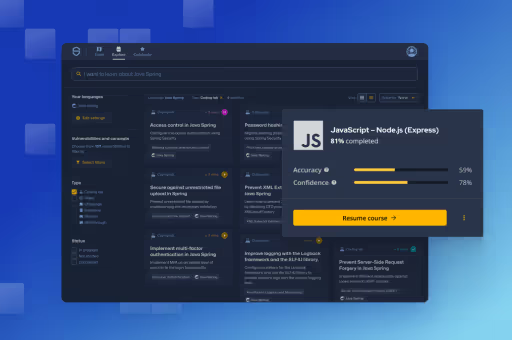
Secure Code Warrior는 전체 소프트웨어 개발 라이프사이클에서 코드를 보호하고 사이버 보안을 최우선으로 생각하는 문화를 조성할 수 있도록 조직을 위해 여기 있습니다.AppSec 관리자, 개발자, CISO 또는 보안 관련 누구든 관계없이 조직이 안전하지 않은 코드와 관련된 위험을 줄일 수 있도록 도와드릴 수 있습니다.
데모 예약


Matias Madou, Ph.D. is a security expert, researcher, and CTO and co-founder of Secure Code Warrior. Matias obtained his Ph.D. in Application Security from Ghent University, focusing on static analysis solutions. He later joined Fortify in the US, where he realized that it was insufficient to solely detect code problems without aiding developers in writing secure code. This inspired him to develop products that assist developers, alleviate the burden of security, and exceed customers' expectations. When he is not at his desk as part of Team Awesome, he enjoys being on stage presenting at conferences including RSA Conference, BlackHat and DefCon.
Matias is a researcher and developer with more than 15 years of hands-on software security experience. He has developed solutions for companies such as Fortify Software and his own company Sensei Security. Over his career, Matias has led multiple application security research projects which have led to commercial products and boasts over 10 patents under his belt. When he is away from his desk, Matias has served as an instructor for advanced application security training courses and regularly speaks at global conferences including RSA Conference, Black Hat, DefCon, BSIMM, OWASP AppSec and BruCon.
Matias holds a Ph.D. in Computer Engineering from Ghent University, where he studied application security through program obfuscation to hide the inner workings of an application.
The mass assignment vulnerability was born because many modern frameworks encourage developers to use functions that automatically bind input from clients into code variables and internal objects. This is done to simplify code and speed up operations.
Attackers can use this methodology to force changes to object properties that should never be updated by a client. Normally this results in business-specific problems, like a user adding admin privileges to themselves as opposed to bringing down a website or stealing corporate secrets. Attackers must also have some idea of the relationships between objects and the business logic of the application they are exploiting.
However, none of that makes the mass assignment vulnerability any less dangerous in the hands of a clever and malicious user.
Before we launch into the full guide, play our gamified challenge and see how you fare:
How can attackers exploit the mass assignment vulnerability?
The scenario put forward by OWASP (and modified slightly by us) assumes a ride-sharing application that includes different properties bound to objects in the code using mass assignment. These include permission-related properties that users can change and process-dependent properties that should only be set internally by the application. Both use mass assignment to bind properties to objects.
In this scenario, the ride-sharing application allows users to update their profiles, as is common in many user-facing applications. This is done using an API call sent to PUT, which returns the following JSON object:
{"user_name":"SneakySnake", "age":17, "is_admin":false}
Because the attacker, Mr. SneakySnake in this case, has figured out the relationship between the properties and the objects, he can resend his original request to update his profile with the following string:
{"user_name":"SneakySnake","age":24,, "is_admin":true}
As the endpoint is vulnerable to mass assignment, it accepts the new input as valid. Not only did our hacker add a few years to his profile, but he also assigned himself admin privileges.
Eliminating the mass assignment vulnerability
As convenient as it might be to use the mass assignment function in some frameworks, you should avoid doing that if you want to keep your APIs secure. Instead, parse request values rather than binding them directly to an object. You can also use a reduced data transfer object which would provide nearly the same convenience as binding directly to the object itself, only without the associated risk.
As an extra precaution, sensitive properties like admin privileges from the example above could be denied so that they will never be accepted by the server on an API call. An even better idea might be to deny every property by default and then allow specific, non-sensitive ones that you want users to be able to update or change. Doing any of those things can help to lock down APIs and eliminate the mass assignment vulnerability from your environment.
Check out the Secure Code Warrior blog pages for more insight about this vulnerability and how to protect your organization and customers from the ravages of other security flaws. You can also try a demo of the Secure Code Warrior training platform to keep all your cybersecurity skills honed and up-to-date.


The mass assignment vulnerability was born because many modern frameworks encourage developers to use functions that automatically bind input from clients into code variables and internal objects. This is done to simplify code and speed up operations.
Attackers can use this methodology to force changes to object properties that should never be updated by a client. Normally this results in business-specific problems, like a user adding admin privileges to themselves as opposed to bringing down a website or stealing corporate secrets. Attackers must also have some idea of the relationships between objects and the business logic of the application they are exploiting.
However, none of that makes the mass assignment vulnerability any less dangerous in the hands of a clever and malicious user.
Before we launch into the full guide, play our gamified challenge and see how you fare:
How can attackers exploit the mass assignment vulnerability?
The scenario put forward by OWASP (and modified slightly by us) assumes a ride-sharing application that includes different properties bound to objects in the code using mass assignment. These include permission-related properties that users can change and process-dependent properties that should only be set internally by the application. Both use mass assignment to bind properties to objects.
In this scenario, the ride-sharing application allows users to update their profiles, as is common in many user-facing applications. This is done using an API call sent to PUT, which returns the following JSON object:
{"user_name":"SneakySnake", "age":17, "is_admin":false}
Because the attacker, Mr. SneakySnake in this case, has figured out the relationship between the properties and the objects, he can resend his original request to update his profile with the following string:
{"user_name":"SneakySnake","age":24,, "is_admin":true}
As the endpoint is vulnerable to mass assignment, it accepts the new input as valid. Not only did our hacker add a few years to his profile, but he also assigned himself admin privileges.
Eliminating the mass assignment vulnerability
As convenient as it might be to use the mass assignment function in some frameworks, you should avoid doing that if you want to keep your APIs secure. Instead, parse request values rather than binding them directly to an object. You can also use a reduced data transfer object which would provide nearly the same convenience as binding directly to the object itself, only without the associated risk.
As an extra precaution, sensitive properties like admin privileges from the example above could be denied so that they will never be accepted by the server on an API call. An even better idea might be to deny every property by default and then allow specific, non-sensitive ones that you want users to be able to update or change. Doing any of those things can help to lock down APIs and eliminate the mass assignment vulnerability from your environment.
Check out the Secure Code Warrior blog pages for more insight about this vulnerability and how to protect your organization and customers from the ravages of other security flaws. You can also try a demo of the Secure Code Warrior training platform to keep all your cybersecurity skills honed and up-to-date.
아래 링크를 클릭하고 이 리소스의 PDF를 다운로드하십시오.
Secure Code Warrior는 전체 소프트웨어 개발 라이프사이클에서 코드를 보호하고 사이버 보안을 최우선으로 생각하는 문화를 조성할 수 있도록 조직을 위해 여기 있습니다.AppSec 관리자, 개발자, CISO 또는 보안 관련 누구든 관계없이 조직이 안전하지 않은 코드와 관련된 위험을 줄일 수 있도록 도와드릴 수 있습니다.
보고서 보기데모 예약
Matias Madou, Ph.D. is a security expert, researcher, and CTO and co-founder of Secure Code Warrior. Matias obtained his Ph.D. in Application Security from Ghent University, focusing on static analysis solutions. He later joined Fortify in the US, where he realized that it was insufficient to solely detect code problems without aiding developers in writing secure code. This inspired him to develop products that assist developers, alleviate the burden of security, and exceed customers' expectations. When he is not at his desk as part of Team Awesome, he enjoys being on stage presenting at conferences including RSA Conference, BlackHat and DefCon.
Matias is a researcher and developer with more than 15 years of hands-on software security experience. He has developed solutions for companies such as Fortify Software and his own company Sensei Security. Over his career, Matias has led multiple application security research projects which have led to commercial products and boasts over 10 patents under his belt. When he is away from his desk, Matias has served as an instructor for advanced application security training courses and regularly speaks at global conferences including RSA Conference, Black Hat, DefCon, BSIMM, OWASP AppSec and BruCon.
Matias holds a Ph.D. in Computer Engineering from Ghent University, where he studied application security through program obfuscation to hide the inner workings of an application.
The mass assignment vulnerability was born because many modern frameworks encourage developers to use functions that automatically bind input from clients into code variables and internal objects. This is done to simplify code and speed up operations.
Attackers can use this methodology to force changes to object properties that should never be updated by a client. Normally this results in business-specific problems, like a user adding admin privileges to themselves as opposed to bringing down a website or stealing corporate secrets. Attackers must also have some idea of the relationships between objects and the business logic of the application they are exploiting.
However, none of that makes the mass assignment vulnerability any less dangerous in the hands of a clever and malicious user.
Before we launch into the full guide, play our gamified challenge and see how you fare:
How can attackers exploit the mass assignment vulnerability?
The scenario put forward by OWASP (and modified slightly by us) assumes a ride-sharing application that includes different properties bound to objects in the code using mass assignment. These include permission-related properties that users can change and process-dependent properties that should only be set internally by the application. Both use mass assignment to bind properties to objects.
In this scenario, the ride-sharing application allows users to update their profiles, as is common in many user-facing applications. This is done using an API call sent to PUT, which returns the following JSON object:
{"user_name":"SneakySnake", "age":17, "is_admin":false}
Because the attacker, Mr. SneakySnake in this case, has figured out the relationship between the properties and the objects, he can resend his original request to update his profile with the following string:
{"user_name":"SneakySnake","age":24,, "is_admin":true}
As the endpoint is vulnerable to mass assignment, it accepts the new input as valid. Not only did our hacker add a few years to his profile, but he also assigned himself admin privileges.
Eliminating the mass assignment vulnerability
As convenient as it might be to use the mass assignment function in some frameworks, you should avoid doing that if you want to keep your APIs secure. Instead, parse request values rather than binding them directly to an object. You can also use a reduced data transfer object which would provide nearly the same convenience as binding directly to the object itself, only without the associated risk.
As an extra precaution, sensitive properties like admin privileges from the example above could be denied so that they will never be accepted by the server on an API call. An even better idea might be to deny every property by default and then allow specific, non-sensitive ones that you want users to be able to update or change. Doing any of those things can help to lock down APIs and eliminate the mass assignment vulnerability from your environment.
Check out the Secure Code Warrior blog pages for more insight about this vulnerability and how to protect your organization and customers from the ravages of other security flaws. You can also try a demo of the Secure Code Warrior training platform to keep all your cybersecurity skills honed and up-to-date.
목차
Matias Madou, Ph.D. is a security expert, researcher, and CTO and co-founder of Secure Code Warrior. Matias obtained his Ph.D. in Application Security from Ghent University, focusing on static analysis solutions. He later joined Fortify in the US, where he realized that it was insufficient to solely detect code problems without aiding developers in writing secure code. This inspired him to develop products that assist developers, alleviate the burden of security, and exceed customers' expectations. When he is not at his desk as part of Team Awesome, he enjoys being on stage presenting at conferences including RSA Conference, BlackHat and DefCon.
Secure Code Warrior는 전체 소프트웨어 개발 라이프사이클에서 코드를 보호하고 사이버 보안을 최우선으로 생각하는 문화를 조성할 수 있도록 조직을 위해 여기 있습니다.AppSec 관리자, 개발자, CISO 또는 보안 관련 누구든 관계없이 조직이 안전하지 않은 코드와 관련된 위험을 줄일 수 있도록 도와드릴 수 있습니다.
데모 예약다운로드시작하는 데 도움이 되는 리소스



시작하는 데 도움이 되는 리소스


Secure coding learning that reflects real AI usage
Align secure coding training to real AI development activity — automatically assigning guidance to developers using AI tools, without manual intervention.Align secure coding training to real AI development activity — automatically assigning guidance to developers using AI tools, without manual intervention.

Train developers on the real risks in their code, whether human-written or AI-generated
Adaptive Learning auto-assigns targeted secure coding training to the developers introducing real vulnerabilities, reducing recurring risks at the source.Secure Code Warrior blog banner with a blue overlay over a developer working at a multi-monitor desk displaying code, alongside the headline 'Train developers on the real risks in their code.'l