

Un avenir meilleur pour DevSecOps ? C'est plus proche que vous ne le pensez


I was delighted to contribute with a number of experts to an insightful article by Suparna Goswami in Data Breach Today. As she points out, there's widespread agreement that addressing security early in the software development life cycle (SDLC) is essential to preventing data breaches, but it's easier said than done. There are some fantastic insights from CISOs, as well as recent survey results showing the biggest application security challenge in continuous integration/continuous delivery (CI/CD) workflows is: "lack of automated, integrated security testing tools".
In my view, DevSecOps should start when the developer starts writing the code. If DevSecOps is going to work effectively, it must begin with developers having the education, skills and tools to write code securely from the start. If developers were taught to write secure code in real-time, or better still - avoid creating many of the bugs in the first place, then security managers and testing tools could focus on finding and fixing the really challenging, complex vulnerabilities in a timely manner.
There are many solutions that find vulnerabilities in code, but security needs to place more emphasis on teaching developers to follow security guidelines that will prevent them from making these mistakes in the first place.
Developers should be assisted to write secure code and fix the vast majority of errors they make as they are writing code, and I am proud to say that the technology now exists to achieve this. Just as spelling and grammar correction tools help writers, developers can now be helped in real-time to write securely, as directed by the relevant language and security policy. In my view, this is the easier, brighter future for DevSecOps.
That's exactly what our Secure Code Warrior Sensei offers - it acts as a real-time security coach for dev teams, controlled by AppSec, ensuring security guidelines are by the developer's side at all times. It will help them code more consistently, more securely and faster. In our early adopter program, we can see it brings down the time to fix issues from an average of three hours per bug to just ten minutes.
We need to use security tools capable of working to a DevSecOps timeline, with efficiency and most importantly, accuracy. It's time to aim for a higher standard of software security.
There are many solutions that find vulnerabilities in code, but security needs to place more emphasis on teaching developers to follow security guidelines that will prevent them from making these mistakes in the first place.

De nombreuses solutions permettent de détecter des vulnérabilités dans le code, mais la sécurité doit mettre davantage l'accent sur l'apprentissage des développeurs à suivre les directives de sécurité qui les empêcheront de commettre ces erreurs dès le départ.
Chief Executive Officer, Chairman, and Co-Founder
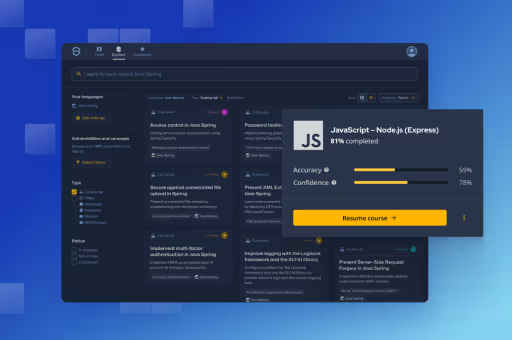
Secure Code Warrior est là pour aider votre organisation à sécuriser le code tout au long du cycle de développement logiciel et à créer une culture dans laquelle la cybersécurité est une priorité. Que vous soyez responsable de la sécurité des applications, développeur, responsable de la sécurité informatique ou toute autre personne impliquée dans la sécurité, nous pouvons aider votre organisation à réduire les risques associés à un code non sécurisé.
Réservez une démo


Chief Executive Officer, Chairman, and Co-Founder
Pieter Danhieux is a globally recognized security expert, with over 12 years experience as a security consultant and 8 years as a Principal Instructor for SANS teaching offensive techniques on how to target and assess organizations, systems and individuals for security weaknesses. In 2016, he was recognized as one of the Coolest Tech people in Australia (Business Insider), awarded Cyber Security Professional of the Year (AISA - Australian Information Security Association) and holds GSE, CISSP, GCIH, GCFA, GSEC, GPEN, GWAPT, GCIA certifications.
I was delighted to contribute with a number of experts to an insightful article by Suparna Goswami in Data Breach Today. As she points out, there's widespread agreement that addressing security early in the software development life cycle (SDLC) is essential to preventing data breaches, but it's easier said than done. There are some fantastic insights from CISOs, as well as recent survey results showing the biggest application security challenge in continuous integration/continuous delivery (CI/CD) workflows is: "lack of automated, integrated security testing tools".
In my view, DevSecOps should start when the developer starts writing the code. If DevSecOps is going to work effectively, it must begin with developers having the education, skills and tools to write code securely from the start. If developers were taught to write secure code in real-time, or better still - avoid creating many of the bugs in the first place, then security managers and testing tools could focus on finding and fixing the really challenging, complex vulnerabilities in a timely manner.
There are many solutions that find vulnerabilities in code, but security needs to place more emphasis on teaching developers to follow security guidelines that will prevent them from making these mistakes in the first place.
Developers should be assisted to write secure code and fix the vast majority of errors they make as they are writing code, and I am proud to say that the technology now exists to achieve this. Just as spelling and grammar correction tools help writers, developers can now be helped in real-time to write securely, as directed by the relevant language and security policy. In my view, this is the easier, brighter future for DevSecOps.
That's exactly what our Secure Code Warrior Sensei offers - it acts as a real-time security coach for dev teams, controlled by AppSec, ensuring security guidelines are by the developer's side at all times. It will help them code more consistently, more securely and faster. In our early adopter program, we can see it brings down the time to fix issues from an average of three hours per bug to just ten minutes.
We need to use security tools capable of working to a DevSecOps timeline, with efficiency and most importantly, accuracy. It's time to aim for a higher standard of software security.
There are many solutions that find vulnerabilities in code, but security needs to place more emphasis on teaching developers to follow security guidelines that will prevent them from making these mistakes in the first place.


I was delighted to contribute with a number of experts to an insightful article by Suparna Goswami in Data Breach Today. As she points out, there's widespread agreement that addressing security early in the software development life cycle (SDLC) is essential to preventing data breaches, but it's easier said than done. There are some fantastic insights from CISOs, as well as recent survey results showing the biggest application security challenge in continuous integration/continuous delivery (CI/CD) workflows is: "lack of automated, integrated security testing tools".
In my view, DevSecOps should start when the developer starts writing the code. If DevSecOps is going to work effectively, it must begin with developers having the education, skills and tools to write code securely from the start. If developers were taught to write secure code in real-time, or better still - avoid creating many of the bugs in the first place, then security managers and testing tools could focus on finding and fixing the really challenging, complex vulnerabilities in a timely manner.
There are many solutions that find vulnerabilities in code, but security needs to place more emphasis on teaching developers to follow security guidelines that will prevent them from making these mistakes in the first place.
Developers should be assisted to write secure code and fix the vast majority of errors they make as they are writing code, and I am proud to say that the technology now exists to achieve this. Just as spelling and grammar correction tools help writers, developers can now be helped in real-time to write securely, as directed by the relevant language and security policy. In my view, this is the easier, brighter future for DevSecOps.
That's exactly what our Secure Code Warrior Sensei offers - it acts as a real-time security coach for dev teams, controlled by AppSec, ensuring security guidelines are by the developer's side at all times. It will help them code more consistently, more securely and faster. In our early adopter program, we can see it brings down the time to fix issues from an average of three hours per bug to just ten minutes.
We need to use security tools capable of working to a DevSecOps timeline, with efficiency and most importantly, accuracy. It's time to aim for a higher standard of software security.
There are many solutions that find vulnerabilities in code, but security needs to place more emphasis on teaching developers to follow security guidelines that will prevent them from making these mistakes in the first place.
Cliquez sur le lien ci-dessous et téléchargez le PDF de cette ressource.
Secure Code Warrior est là pour aider votre organisation à sécuriser le code tout au long du cycle de développement logiciel et à créer une culture dans laquelle la cybersécurité est une priorité. Que vous soyez responsable de la sécurité des applications, développeur, responsable de la sécurité informatique ou toute autre personne impliquée dans la sécurité, nous pouvons aider votre organisation à réduire les risques associés à un code non sécurisé.
Afficher le rapportRéservez une démo
Chief Executive Officer, Chairman, and Co-Founder
Pieter Danhieux is a globally recognized security expert, with over 12 years experience as a security consultant and 8 years as a Principal Instructor for SANS teaching offensive techniques on how to target and assess organizations, systems and individuals for security weaknesses. In 2016, he was recognized as one of the Coolest Tech people in Australia (Business Insider), awarded Cyber Security Professional of the Year (AISA - Australian Information Security Association) and holds GSE, CISSP, GCIH, GCFA, GSEC, GPEN, GWAPT, GCIA certifications.
I was delighted to contribute with a number of experts to an insightful article by Suparna Goswami in Data Breach Today. As she points out, there's widespread agreement that addressing security early in the software development life cycle (SDLC) is essential to preventing data breaches, but it's easier said than done. There are some fantastic insights from CISOs, as well as recent survey results showing the biggest application security challenge in continuous integration/continuous delivery (CI/CD) workflows is: "lack of automated, integrated security testing tools".
In my view, DevSecOps should start when the developer starts writing the code. If DevSecOps is going to work effectively, it must begin with developers having the education, skills and tools to write code securely from the start. If developers were taught to write secure code in real-time, or better still - avoid creating many of the bugs in the first place, then security managers and testing tools could focus on finding and fixing the really challenging, complex vulnerabilities in a timely manner.
There are many solutions that find vulnerabilities in code, but security needs to place more emphasis on teaching developers to follow security guidelines that will prevent them from making these mistakes in the first place.
Developers should be assisted to write secure code and fix the vast majority of errors they make as they are writing code, and I am proud to say that the technology now exists to achieve this. Just as spelling and grammar correction tools help writers, developers can now be helped in real-time to write securely, as directed by the relevant language and security policy. In my view, this is the easier, brighter future for DevSecOps.
That's exactly what our Secure Code Warrior Sensei offers - it acts as a real-time security coach for dev teams, controlled by AppSec, ensuring security guidelines are by the developer's side at all times. It will help them code more consistently, more securely and faster. In our early adopter program, we can see it brings down the time to fix issues from an average of three hours per bug to just ten minutes.
We need to use security tools capable of working to a DevSecOps timeline, with efficiency and most importantly, accuracy. It's time to aim for a higher standard of software security.
There are many solutions that find vulnerabilities in code, but security needs to place more emphasis on teaching developers to follow security guidelines that will prevent them from making these mistakes in the first place.
Table des matières
Chief Executive Officer, Chairman, and Co-Founder
Secure Code Warrior est là pour aider votre organisation à sécuriser le code tout au long du cycle de développement logiciel et à créer une culture dans laquelle la cybersécurité est une priorité. Que vous soyez responsable de la sécurité des applications, développeur, responsable de la sécurité informatique ou toute autre personne impliquée dans la sécurité, nous pouvons aider votre organisation à réduire les risques associés à un code non sécurisé.
Réservez une démoTéléchargerRessources pour vous aider à démarrer



Ressources pour vous aider à démarrer
Secure Code Warrior named twice in the Gartner Hype Cycle for secure software engineering
Gartner names SCW twice. As AI agents take over more development, SCW gives you the capability and governance to adopt AI-driven development securely.



Secure coding learning that reflects real AI usage
Align secure coding training to real AI development activity — automatically assigning guidance to developers using AI tools, without manual intervention.Align secure coding training to real AI development activity — automatically assigning guidance to developers using AI tools, without manual intervention.
Train developers on the real risks in their code, whether human-written or AI-generated
Adaptive Learning auto-assigns targeted secure coding training to the developers introducing real vulnerabilities, reducing recurring risks at the source.Secure Code Warrior blog banner with a blue overlay over a developer working at a multi-monitor desk displaying code, alongside the headline 'Train developers on the real risks in their code.'l