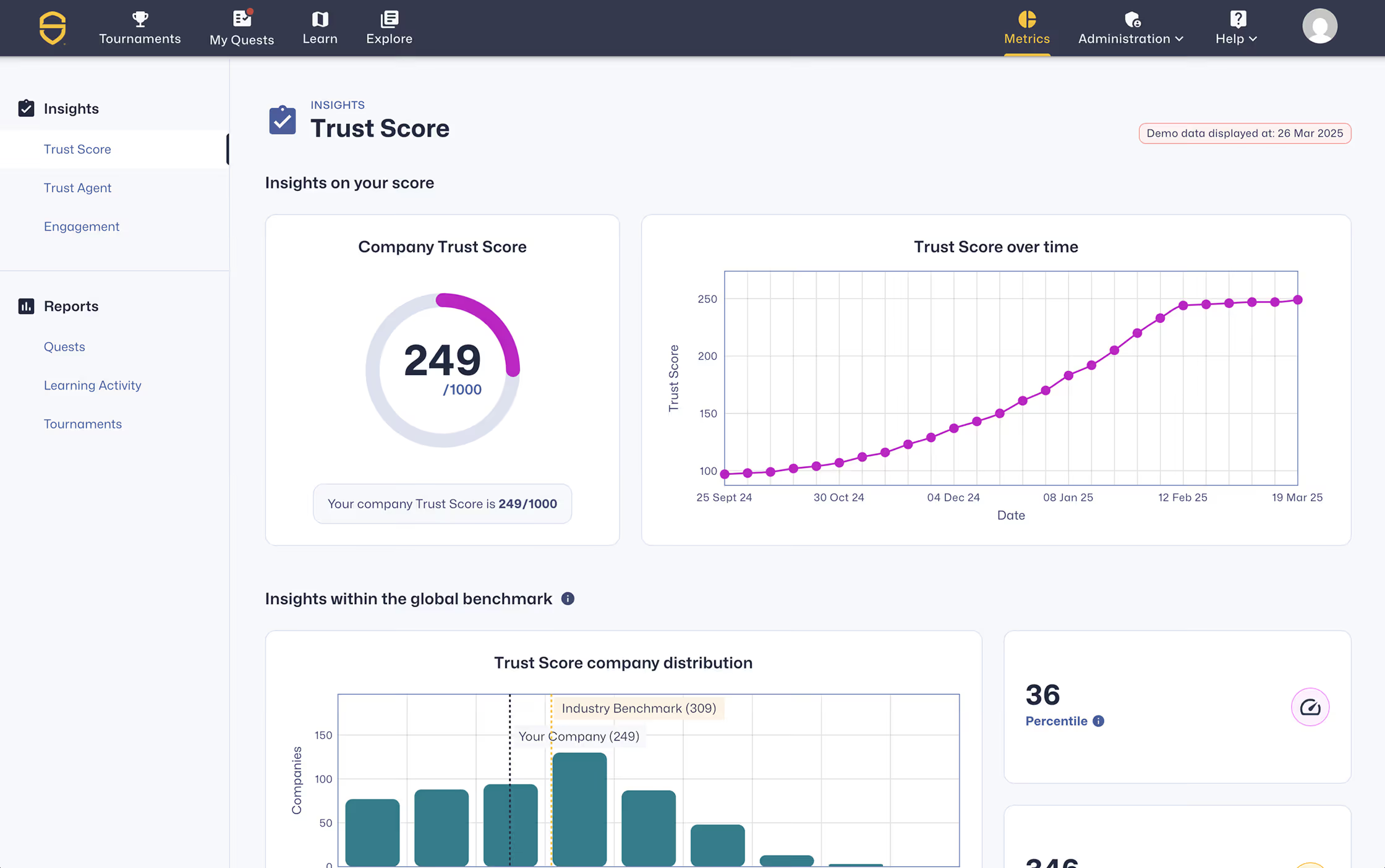
AI in the SDLC: Separating the Hype from the Security Reality
AI in the SDLC, presented in partnership with KnowBe4: Kawin Boonyapredee (CISO Advisor, KnowBe4) and Pieter Danhieux (CEO, SCW) unpack AI code security risks.
Autonomous AI development is no longer the future, it’s the present-day security conundrum many enterprise security leaders are already facing. According to data from McKinsey, 31% of enterprises have at least one AI agent in production, with many of these early adopters sitting in highly regulated, high-risk environments like banking, financial services and healthcare.
Implementation of this technology is far outpacing regulation, and the risk signals are alarming. Research from Secure Code Warrior and RMIT University found that there is no universally secure model and that AI-generated code carries an average of 15 vulnerabilities per codebase. This is a growing, powerful threat vector that must be understood and defended against by every developer - or even “citizen developer” before code enters production.
Earlier this year, KnowBe4 and Secure Code Warrior announced a strategic partnership to deliver a specialized suite of secure coding content to the KnowBe4 attack simulation and training library, designed to provide foundational security awareness for organizations with technical roles. Now, they join forces with two prominent security experts, Kawin Boonyapredeeto, CISO Advisor at KnowBe4 and Pieter Danhieux, CEO and Co-Founder of Secure Code Warrior, to deliver the latest thought leadership on AI-assisted development and implementation, and what you need to know to utilize these tools safely and effectively in your organization.
They will present the following key talks:
The Autonomous Developer: Architecting the Future of Software Delivery
Kawin Boonyapredee, CISO Advisor
Software and application development has undergone a fundamental evolution, moving from the rigid punch cards of the 1950s to highly scalable, abstraction-heavy modern programming frameworks. Today, the industry stands at the precipice of its most disruptive paradigm shift yet: the rise of Artificial Intelligence as an autonomous software developer.
This executive presentation explores the trajectory of development methodologies, from the invention of compilers and continuous integration to the current era of goal-driven AI agents and generative swarms. We will analyze how Large Language Models (LLMs) and advanced agentic architectures are automating routine tasks, boilerplate generation, and basic debugging. Crucially, this shift democratizes coding while raising the abstraction layer at which organizations must operate.
For executive and engineering leadership, understanding this shift is critical. Human engineers are no longer just individual contributors writing every line of code; they are rapidly transitioning into AI orchestrators. This role requires shifting from manual implementation to high-level systems thinking: defining specifications, establishing architectural guardrails, configuring context for AI agents, and rigorously verifying the resulting systems.
Are all LLMs equally good (or bad) at creating secure code?
Pieter Danhieux, CEO & Co-Founder, Secure Code Warrior
In this presentation, we reveal the industry-first results of the SCW AI Trust Index, a large-scale study and benchmark that evaluates the security behavior of leading AI coding models from multiple vendors, measuring how often they generate vulnerable code in common software development scenarios.
Our research reveals a striking result: there is no universally secure model, and AI-generated code carries an average of 15 vulnerabilities per codebase.
We analyze the repeatable, predictable vulnerability patterns arising from AI-generated code and explore the implications for organizations integrating AI into their software supply chains. Attendees will learn how AI-generated code introduces a new “shadow layer” inside the SDLC, how to detect AI and MCP influence in development pipelines, and how security teams can reduce risk when deploying AI coding tools and agents at scale.
The benchmark evaluates model-generated code across development tasks, including:
- Authentication flows
- Input validation
- Database operations
- API integrations
- Cryptographic usage
The research highlights the emergence of a previously unmeasured risk layer within modern software development pipelines: AI-generated code that may enter production without clear visibility or security validation. The presentation will include benchmark methodology, vulnerability analysis across models, and practical techniques for reducing risk in AI-assisted development environments.
If you are looking to make more secure, cost-effective, and contextually relevant choices when integrating AI tooling into your tech stack, then this webinar is unmissable.
Explore more events and webinars
Access expert content on secure coding, AI governance, and software risk management.

OWASP Global AppSec USA
Proud to be a Silver Sponsor of OWASP Global AppSec USA 2026, celebrating its 25th anniversary on November 5–6, 2026, at the Hyatt Regency in San Francisco! Join us and 800+ application security professionals for sessions on AI security, threat modeling, a Capture the Flag competition, the OWASP Projects Demo Room, and exclusive networking receptions. Come find us there and let's connect!

OWASP LASCON
We are proud to be a Gold Sponsor for OWASP LASCON 2026 in Austin, TX! Join us at the Norris Conference Center as we gather with over 400 web developers and security professionals to share cutting-edge ideas in application security.
Secure AI-driven development before it ships
See developer risk, enforce policy, and prevent vulnerabilities across your software development lifecycle.