

LLM 애플리케이션을 위한 OWASP 상위 10위: 새로운 기능, 변경된 기능 및 보안을 유지하는 방법


Taking a proactive approach to securing your software requires that you stay at the forefront of the latest standards and compliance requirements. After all, the cybersecurity landscape is constantly in motion with new threats and vulnerabilities, especially as new technologies emerge. Never has this been more true than today where we collectively sit at an inflection point of AI where new evolutions and use cases seem to emerge every day.
To address these challenges, The OWASP Foundation recently released its updated version of the OWASP Top 10 for Large Language Model (LLM) Applications, which seeks to inform developers, architects and other contributors to software delivery of the potential risks when deploying LLMs and Generative AI applications. And we at Secure Code Warrior are excited to announce that the changes and updates in this latest version are already implemented and available in our secure code learning platform. With these newly available and updated materials, all of our users can stay at the forefront of risk mitigation when utilizing LLMs.
What is new in this update?
OWASP has removed two items from its previous Top 10:
- Insecure Plugin Design - which relates to how LLMs interact with plugins and how plugins interact with external storage or services.
- Model Theft - referring to unauthorized replication or acquisition of machine learning models or AI system.
In accordance with previous versions of the OWASP Top 10, Secure Code Warrior had Guidelines associated with these vulnerabilities as part of our LLM Top 10 Course. These Guidelines, which provide digestible information regarding vulnerabilities and security concepts in an easy-to-understand, readable format, have since been removed from the Course curriculum. However, the guidelines remain available in Explore, along with all the other learning materials we have to offer.
Keeping its Top 10 to an official 10, OWASP has added two new items:
- System Prompt Leakage - where typically hidden prompts that guide a model's behavior get exposed to users.
- Vector and Embedding - which can expose specific, proprietary, or real-time information that is not publicly available
Guidelines for these vulnerabilities have been added to the LLM Top 10 Course, and just like the Guidelines that were removed, these two are also accessible in Explore for users that want to take advantage of self-paced learning.
Lastly, OWASP also made some changes to existing vulnerability categories in its list, renaming some categories to be more expansive or specific, and making modifications to their definitions. Our Guidelines supporting these topics have now been updated to reflect both the minor changes from OWASP’s guidance as well as the new naming conventions. Additionally their listing in order of priority has been updated to match the order set in the OWASP LLM Top 10.
At Secure Code Warrior, we’re committed to helping our users stay ahead of the curve. With the latest OWASP updates already reflected in our agile learning platform, we’ve made it easy for our users to access up-to-date training materials that cover the most current vulnerabilities and mitigate risk when deploying LLM and Generative AI technologies. Whether you’re navigating the newly introduced threats of System Prompt Leakage or Vector and Embedding, or updating your understanding of Misinformation and Unbounded Consumption, our platform provides the resources you need to master these critical concepts improving your security posture.

최신 OWASP Top 10 업데이트를 통해 LLM 애플리케이션의 보안을 한 발 앞서 나가십시오.새로운 기능, 변경된 사항, Secure Code Warrior가 제너레이티브 AI의 위험을 완화하는 데 필요한 최신 학습 리소스를 어떻게 제공하는지 알아보십시오.
Secure Code Warrior makes secure coding a positive and engaging experience for developers as they increase their skills. We guide each coder along their own preferred learning pathway, so that security-skilled developers become the everyday superheroes of our connected world.
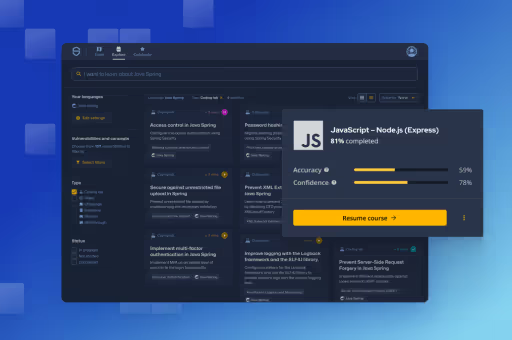
Secure Code Warrior는 전체 소프트웨어 개발 라이프사이클에서 코드를 보호하고 사이버 보안을 최우선으로 생각하는 문화를 조성할 수 있도록 조직을 위해 여기 있습니다.AppSec 관리자, 개발자, CISO 또는 보안 관련 누구든 관계없이 조직이 안전하지 않은 코드와 관련된 위험을 줄일 수 있도록 도와드릴 수 있습니다.
데모 예약


Secure Code Warrior makes secure coding a positive and engaging experience for developers as they increase their skills. We guide each coder along their own preferred learning pathway, so that security-skilled developers become the everyday superheroes of our connected world.
This article was written by Secure Code Warrior's team of industry experts, committed to empowering developers with the knowledge and skills to build secure software from the start. Drawing on deep expertise in secure coding practices, industry trends, and real-world insights.
Taking a proactive approach to securing your software requires that you stay at the forefront of the latest standards and compliance requirements. After all, the cybersecurity landscape is constantly in motion with new threats and vulnerabilities, especially as new technologies emerge. Never has this been more true than today where we collectively sit at an inflection point of AI where new evolutions and use cases seem to emerge every day.
To address these challenges, The OWASP Foundation recently released its updated version of the OWASP Top 10 for Large Language Model (LLM) Applications, which seeks to inform developers, architects and other contributors to software delivery of the potential risks when deploying LLMs and Generative AI applications. And we at Secure Code Warrior are excited to announce that the changes and updates in this latest version are already implemented and available in our secure code learning platform. With these newly available and updated materials, all of our users can stay at the forefront of risk mitigation when utilizing LLMs.
What is new in this update?
OWASP has removed two items from its previous Top 10:
- Insecure Plugin Design - which relates to how LLMs interact with plugins and how plugins interact with external storage or services.
- Model Theft - referring to unauthorized replication or acquisition of machine learning models or AI system.
In accordance with previous versions of the OWASP Top 10, Secure Code Warrior had Guidelines associated with these vulnerabilities as part of our LLM Top 10 Course. These Guidelines, which provide digestible information regarding vulnerabilities and security concepts in an easy-to-understand, readable format, have since been removed from the Course curriculum. However, the guidelines remain available in Explore, along with all the other learning materials we have to offer.
Keeping its Top 10 to an official 10, OWASP has added two new items:
- System Prompt Leakage - where typically hidden prompts that guide a model's behavior get exposed to users.
- Vector and Embedding - which can expose specific, proprietary, or real-time information that is not publicly available
Guidelines for these vulnerabilities have been added to the LLM Top 10 Course, and just like the Guidelines that were removed, these two are also accessible in Explore for users that want to take advantage of self-paced learning.
Lastly, OWASP also made some changes to existing vulnerability categories in its list, renaming some categories to be more expansive or specific, and making modifications to their definitions. Our Guidelines supporting these topics have now been updated to reflect both the minor changes from OWASP’s guidance as well as the new naming conventions. Additionally their listing in order of priority has been updated to match the order set in the OWASP LLM Top 10.
At Secure Code Warrior, we’re committed to helping our users stay ahead of the curve. With the latest OWASP updates already reflected in our agile learning platform, we’ve made it easy for our users to access up-to-date training materials that cover the most current vulnerabilities and mitigate risk when deploying LLM and Generative AI technologies. Whether you’re navigating the newly introduced threats of System Prompt Leakage or Vector and Embedding, or updating your understanding of Misinformation and Unbounded Consumption, our platform provides the resources you need to master these critical concepts improving your security posture.


Taking a proactive approach to securing your software requires that you stay at the forefront of the latest standards and compliance requirements. After all, the cybersecurity landscape is constantly in motion with new threats and vulnerabilities, especially as new technologies emerge. Never has this been more true than today where we collectively sit at an inflection point of AI where new evolutions and use cases seem to emerge every day.
To address these challenges, The OWASP Foundation recently released its updated version of the OWASP Top 10 for Large Language Model (LLM) Applications, which seeks to inform developers, architects and other contributors to software delivery of the potential risks when deploying LLMs and Generative AI applications. And we at Secure Code Warrior are excited to announce that the changes and updates in this latest version are already implemented and available in our secure code learning platform. With these newly available and updated materials, all of our users can stay at the forefront of risk mitigation when utilizing LLMs.
What is new in this update?
OWASP has removed two items from its previous Top 10:
- Insecure Plugin Design - which relates to how LLMs interact with plugins and how plugins interact with external storage or services.
- Model Theft - referring to unauthorized replication or acquisition of machine learning models or AI system.
In accordance with previous versions of the OWASP Top 10, Secure Code Warrior had Guidelines associated with these vulnerabilities as part of our LLM Top 10 Course. These Guidelines, which provide digestible information regarding vulnerabilities and security concepts in an easy-to-understand, readable format, have since been removed from the Course curriculum. However, the guidelines remain available in Explore, along with all the other learning materials we have to offer.
Keeping its Top 10 to an official 10, OWASP has added two new items:
- System Prompt Leakage - where typically hidden prompts that guide a model's behavior get exposed to users.
- Vector and Embedding - which can expose specific, proprietary, or real-time information that is not publicly available
Guidelines for these vulnerabilities have been added to the LLM Top 10 Course, and just like the Guidelines that were removed, these two are also accessible in Explore for users that want to take advantage of self-paced learning.
Lastly, OWASP also made some changes to existing vulnerability categories in its list, renaming some categories to be more expansive or specific, and making modifications to their definitions. Our Guidelines supporting these topics have now been updated to reflect both the minor changes from OWASP’s guidance as well as the new naming conventions. Additionally their listing in order of priority has been updated to match the order set in the OWASP LLM Top 10.
At Secure Code Warrior, we’re committed to helping our users stay ahead of the curve. With the latest OWASP updates already reflected in our agile learning platform, we’ve made it easy for our users to access up-to-date training materials that cover the most current vulnerabilities and mitigate risk when deploying LLM and Generative AI technologies. Whether you’re navigating the newly introduced threats of System Prompt Leakage or Vector and Embedding, or updating your understanding of Misinformation and Unbounded Consumption, our platform provides the resources you need to master these critical concepts improving your security posture.
아래 링크를 클릭하고 이 리소스의 PDF를 다운로드하십시오.
Secure Code Warrior는 전체 소프트웨어 개발 라이프사이클에서 코드를 보호하고 사이버 보안을 최우선으로 생각하는 문화를 조성할 수 있도록 조직을 위해 여기 있습니다.AppSec 관리자, 개발자, CISO 또는 보안 관련 누구든 관계없이 조직이 안전하지 않은 코드와 관련된 위험을 줄일 수 있도록 도와드릴 수 있습니다.
보고서 보기데모 예약
Secure Code Warrior makes secure coding a positive and engaging experience for developers as they increase their skills. We guide each coder along their own preferred learning pathway, so that security-skilled developers become the everyday superheroes of our connected world.
This article was written by Secure Code Warrior's team of industry experts, committed to empowering developers with the knowledge and skills to build secure software from the start. Drawing on deep expertise in secure coding practices, industry trends, and real-world insights.
Taking a proactive approach to securing your software requires that you stay at the forefront of the latest standards and compliance requirements. After all, the cybersecurity landscape is constantly in motion with new threats and vulnerabilities, especially as new technologies emerge. Never has this been more true than today where we collectively sit at an inflection point of AI where new evolutions and use cases seem to emerge every day.
To address these challenges, The OWASP Foundation recently released its updated version of the OWASP Top 10 for Large Language Model (LLM) Applications, which seeks to inform developers, architects and other contributors to software delivery of the potential risks when deploying LLMs and Generative AI applications. And we at Secure Code Warrior are excited to announce that the changes and updates in this latest version are already implemented and available in our secure code learning platform. With these newly available and updated materials, all of our users can stay at the forefront of risk mitigation when utilizing LLMs.
What is new in this update?
OWASP has removed two items from its previous Top 10:
- Insecure Plugin Design - which relates to how LLMs interact with plugins and how plugins interact with external storage or services.
- Model Theft - referring to unauthorized replication or acquisition of machine learning models or AI system.
In accordance with previous versions of the OWASP Top 10, Secure Code Warrior had Guidelines associated with these vulnerabilities as part of our LLM Top 10 Course. These Guidelines, which provide digestible information regarding vulnerabilities and security concepts in an easy-to-understand, readable format, have since been removed from the Course curriculum. However, the guidelines remain available in Explore, along with all the other learning materials we have to offer.
Keeping its Top 10 to an official 10, OWASP has added two new items:
- System Prompt Leakage - where typically hidden prompts that guide a model's behavior get exposed to users.
- Vector and Embedding - which can expose specific, proprietary, or real-time information that is not publicly available
Guidelines for these vulnerabilities have been added to the LLM Top 10 Course, and just like the Guidelines that were removed, these two are also accessible in Explore for users that want to take advantage of self-paced learning.
Lastly, OWASP also made some changes to existing vulnerability categories in its list, renaming some categories to be more expansive or specific, and making modifications to their definitions. Our Guidelines supporting these topics have now been updated to reflect both the minor changes from OWASP’s guidance as well as the new naming conventions. Additionally their listing in order of priority has been updated to match the order set in the OWASP LLM Top 10.
At Secure Code Warrior, we’re committed to helping our users stay ahead of the curve. With the latest OWASP updates already reflected in our agile learning platform, we’ve made it easy for our users to access up-to-date training materials that cover the most current vulnerabilities and mitigate risk when deploying LLM and Generative AI technologies. Whether you’re navigating the newly introduced threats of System Prompt Leakage or Vector and Embedding, or updating your understanding of Misinformation and Unbounded Consumption, our platform provides the resources you need to master these critical concepts improving your security posture.
목차
Secure Code Warrior makes secure coding a positive and engaging experience for developers as they increase their skills. We guide each coder along their own preferred learning pathway, so that security-skilled developers become the everyday superheroes of our connected world.
Secure Code Warrior는 전체 소프트웨어 개발 라이프사이클에서 코드를 보호하고 사이버 보안을 최우선으로 생각하는 문화를 조성할 수 있도록 조직을 위해 여기 있습니다.AppSec 관리자, 개발자, CISO 또는 보안 관련 누구든 관계없이 조직이 안전하지 않은 코드와 관련된 위험을 줄일 수 있도록 도와드릴 수 있습니다.
데모 예약다운로드시작하는 데 도움이 되는 리소스


시작하는 데 도움이 되는 리소스
%20thumbnail.png)

Secure coding learning that reflects real AI usage
Align secure coding training to real AI development activity — automatically assigning guidance to developers using AI tools, without manual intervention.Align secure coding training to real AI development activity — automatically assigning guidance to developers using AI tools, without manual intervention.